The Order of Operations
What is 2 + 3 × 4? Noah says 20. Zoe says 14. They can't both be right. Who is?
One order for everyone
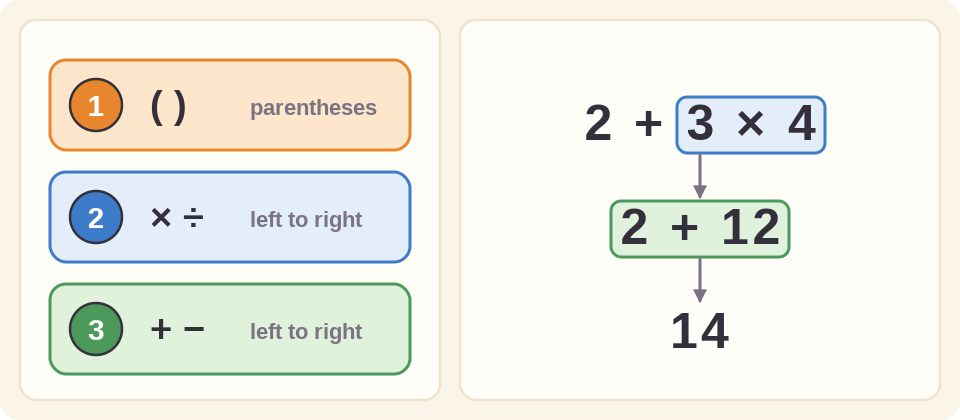
So everyone gets the same answer, mathematicians agree on an order. It is called the order of operations.
-
Parentheses first.
-
Then multiply and divide, from left to right.
-
Then add and subtract, from left to right.
In 2 + 3 × 4, multiply first: 3 × 4 = 12. Then add: 2 + 12 = 14. Zoe is right.
Left to right
Multiply and divide are a team. Do them in the order you meet them, from the left.
12 ÷ 3 × 2: first 12 ÷ 3 = 4, then 4 × 2 = 8.
Add and subtract are a team too. 10 - 4 + 3: first 10 - 4 = 6, then 6 + 3 = 9.
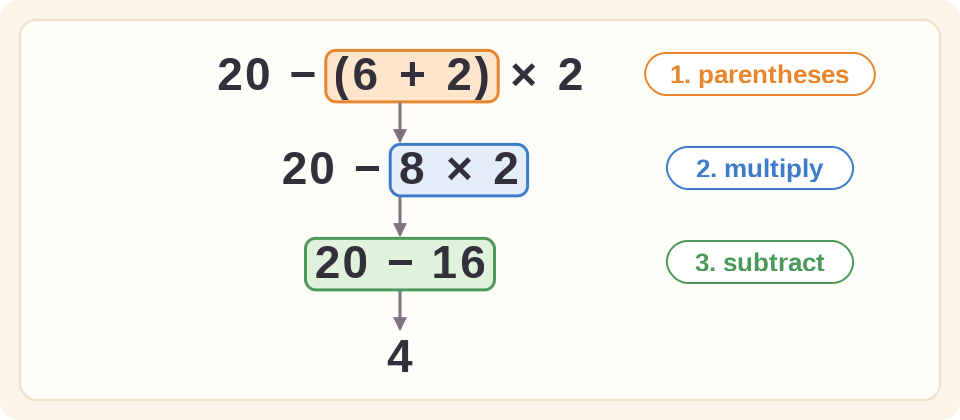
Here is a longer one: 20 - (6 + 2) × 2 = 20 - 8 × 2 = 20 - 16 = 4.
Try it at home
- Write 5 + 2 × 3 on paper.
- Ask someone at home to work it out.
- Did they get 11? Show them the order of operations.
Words in this lesson
- order of operations - the order everyone uses: parentheses, then × and ÷, then + and -.
Big idea
Parentheses first, then multiply and divide from left to right, then add and subtract from left to right.