Cubic Centimeters and Liters
A liter of milk and a box of 1,000 sugar cubes, each 1 cm on a side, take up the same space. Why?
A liter is a cube
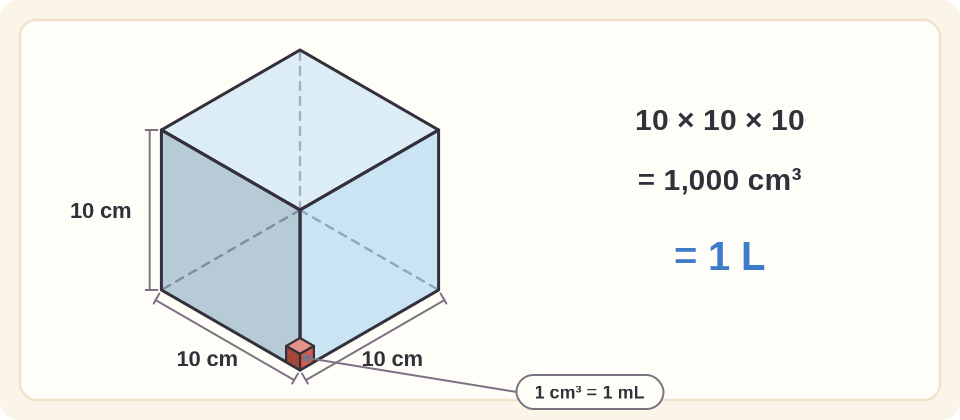
Picture a hollow cube 10 cm long, 10 cm wide and 10 cm high.
Its volume is 10 × 10 × 10 = 1,000 cubic centimeters.
Fill it with water, and it holds exactly 1 liter. So 1 L = 1,000 cm³.
That means 1 cubic centimeter holds 1 milliliter. Doctors and cooks often write it as cc: 5 cc of medicine is 5 mL.
How much does a tank hold?
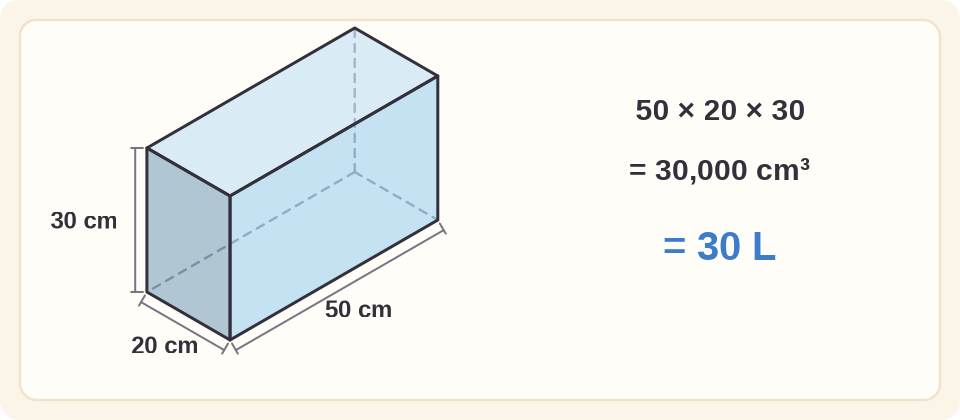
A fish tank is 50 cm long, 20 cm wide and 30 cm high.
Its volume is 50 × 20 × 30 = 30,000 cm³.
Every 1,000 cm³ is a liter, so 30,000 ÷ 1,000 = 30 liters.
Going the other way: a 1.5 L bottle holds 1.5 × 1,000 = 1,500 cm³.
Try it at home
- Find a box that is close to 10 cm on each side.
- Line it with a plastic bag and pour in 1 liter of water.
- Does it fill the box?
Words in this lesson
- liter - the space of a cube 10 cm on each side: 1,000 cm³.
- cc - short for cubic centimeter, the same as a milliliter.
Big idea
1,000 cubic centimeters make a liter, so 1 cubic centimeter is 1 milliliter.