Powers of Ten with Exponents
One million is 10 × 10 × 10 × 10 × 10 × 10. That is a long thing to write! Mathematicians have a much shorter way.
A small number up high
When you multiply the same number again and again, you can write it as a power.
2 × 2 × 2 is written 2³. The big 2 is the number you multiply. The small 3 is the exponent: it counts how many 2s.
So 2³ = 2 × 2 × 2 = 8. It is not 2 × 3!
3² is said "3 squared." It is 3 × 3 = 9, a square of 9 blocks. 3³ is "3 cubed": 3 × 3 × 3 = 27, a cube of 27 blocks.
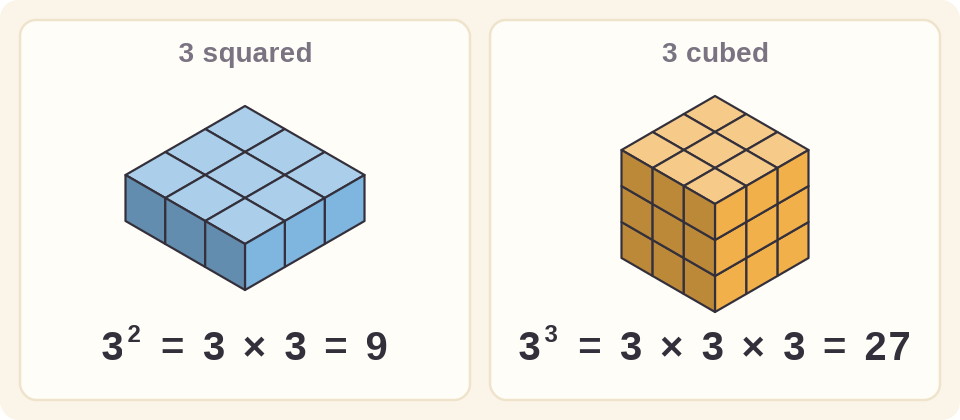
Powers of ten
Now multiply tens. 10² = 10 × 10 = 100. 10³ = 10 × 10 × 10 = 1,000.
Look at the zeros. 10³ has 3 zeros. 10⁶ has 6 zeros: 1,000,000, one million.
The exponent of a power of ten tells you how many zeros come after the 1.
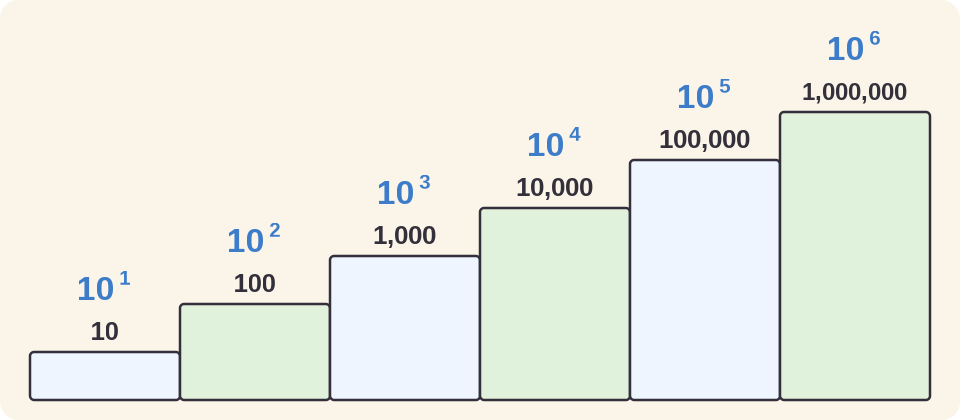
Try it at home
- Fold a sheet of paper in half. Now it is 2 layers thick.
- Fold it again and again. Each fold doubles the layers: 2, 4, 8...
- After 5 folds you have 2⁵ layers. How many is that?
Words in this lesson
- power - a number multiplied by itself again and again, like 2 × 2 × 2.
- exponent - the small raised number that counts how many times to multiply.
Big idea
An exponent counts how many times a number is multiplied, and 10 to a power is 1 followed by that many zeros.