Parentheses Come First
Maya has 20 stickers. Leo writes 20 - 5 + 3. Is the answer 18 or 12? It depends on what you do first.
Two different answers
A math phrase with numbers and signs, like 20 - 5 + 3, is an expression.
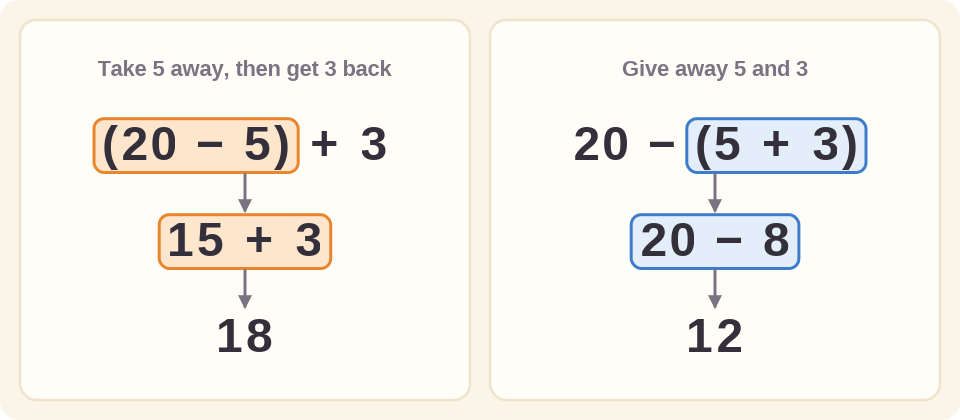
Work it from the left: 20 - 5 = 15, then 15 + 3 = 18.
But maybe Maya gave away 5 stickers and 3 stickers. Then she gave 5 + 3 = 8, and 20 - 8 = 12.
To show that, write parentheses around the part to do first: 20 - (5 + 3) = 12.
Parentheses change the answer
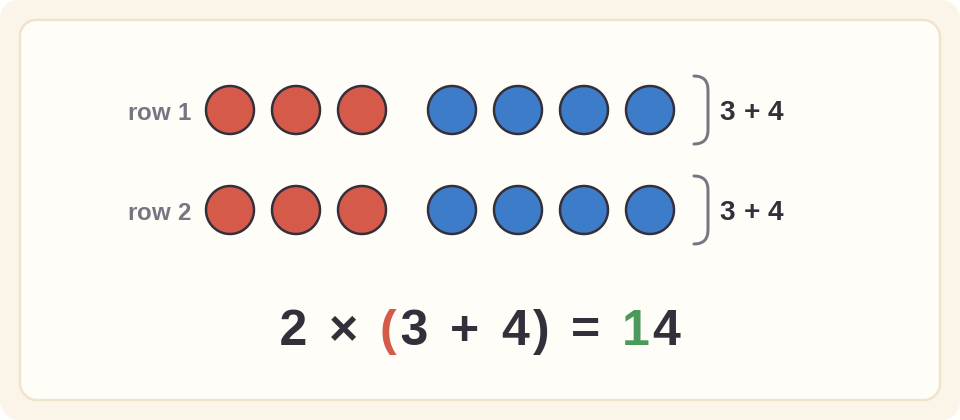
2 × (3 + 4) means: first 3 + 4 = 7, then 2 × 7 = 14.
(2 × 3) + 4 means: first 2 × 3 = 6, then 6 + 4 = 10.
Same numbers, same signs, different answers. The parentheses decide.
Think of 2 × (3 + 4) as 2 rows, each with 3 red dots and 4 blue dots.
Try it at home
- Get 12 coins or buttons.
- Show 12 - (4 + 2): take away 4 and 2 together. How many are left?
- Start again and show (12 - 4) + 2. Is the answer the same?
Words in this lesson
- expression - numbers and signs that stand for an amount, like 20 - 5 + 3.
- parentheses - the curved marks ( ) around the part to work out first.
Big idea
Work out the part in parentheses first; moving the parentheses can change the answer.