Estimating with Benchmark Fractions
Ben added + and got . Before working it out, can you tell he is wrong?
Benchmarks: 0, one half and 1
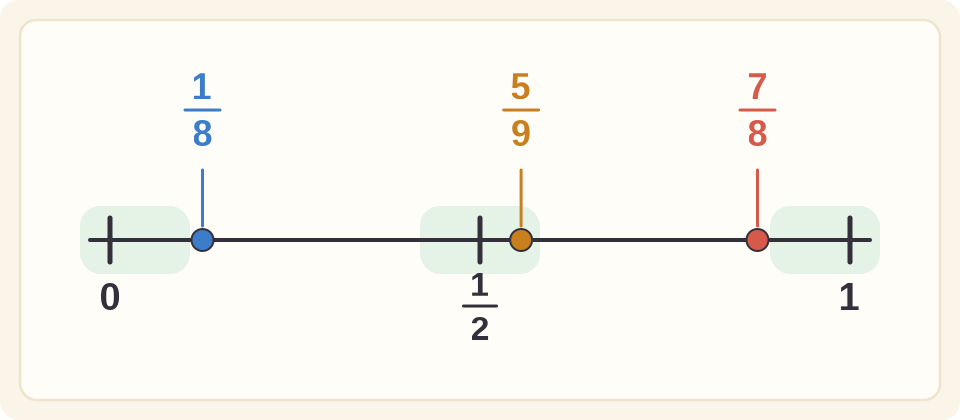
A benchmark is a number you know well. For fractions, 0, and 1 are good ones.
is close to 0. is close to . is close to 1.
To check, compare the top with half the bottom: 5 is a little more than half of 9.
Estimate first
is close to . So + is close to + = 1.
But is less than one half. Ben added the tops and the bottoms! The real sum is , close to 1.
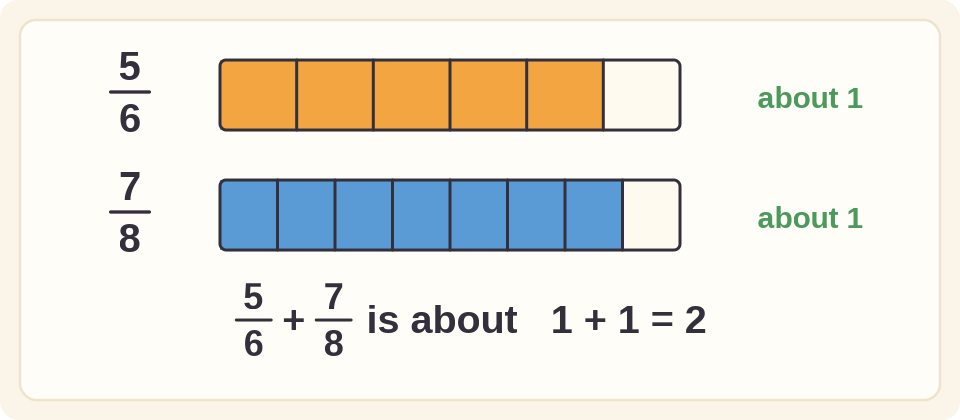
Another: + . Each is close to 1, so the sum is close to 2. It is a bit less than 2, since both are less than 1.
Try it at home
- Write five fractions on cards, like 1/9, 4/7, 11/12, 3/5 and 1/10.
- Sort them into three piles: close to 0, close to 1/2, close to 1.
- Pick two cards and estimate their sum.
Words in this lesson
- benchmark - a number you know well and compare others with, like 0, 1/2 or 1.
- estimate - to find a number close to the answer, to check that an answer makes sense.
Big idea
Round each fraction to 0, one half or 1 to estimate a sum and check an answer.