Multiplying by 10, 100 and 1,000
A box holds 56 pencils. A school orders 1,000 boxes. How many pencils is that? You can know in a second.
Every digit moves left
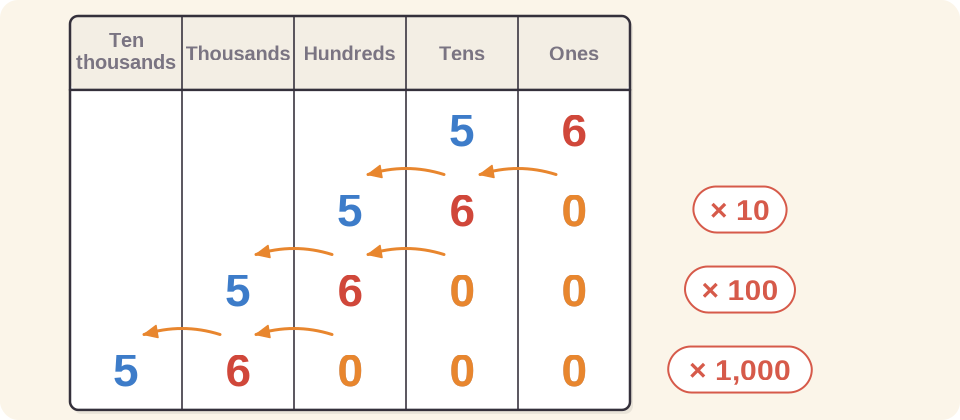
Multiply 56 by 10. Each ten becomes a hundred, and each one becomes a ten.
So every digit moves one place to the left, and a 0 fills the ones place: 56 × 10 = 560.
Times 100 moves every digit two places: 56 × 100 = 5,600.
Times 1,000, or 10³, moves them three places: 56 × 1,000 = 56,000 pencils.
Round numbers in your head
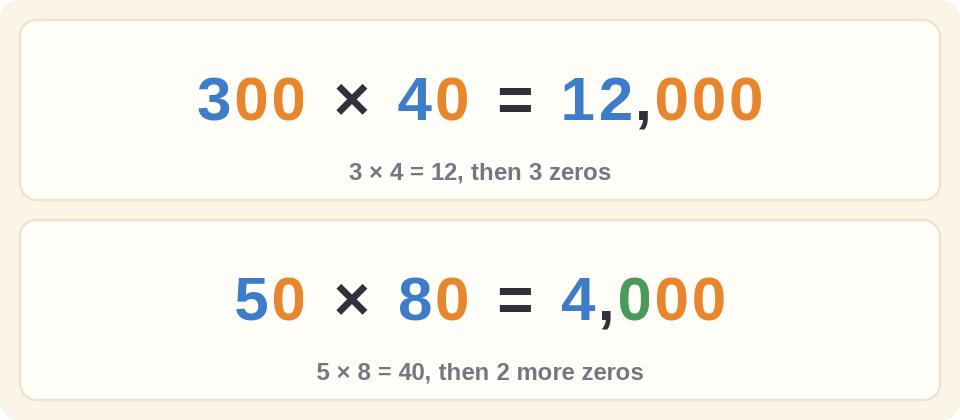
What is 300 × 40? First multiply the digits that aren't zeros: 3 × 4 = 12.
Then count the zeros: two in 300 and one in 40. Put all three on 12: 12,000.
Watch for a hidden zero. For 50 × 80, the digits give 5 × 8 = 40. That 40 has its own zero!
Add the two zeros from 50 and 80, and you get 4,000.
Try it at home
- Type 7 into a calculator.
- Multiply by 10 three times. Write each answer down.
- Where did the 7 go each time?
Words in this lesson
- power of ten - 10, 100, 1,000 and so on: 10 multiplied by itself.
Big idea
Multiplying by 10, 100 or 1,000 moves every digit one, two or three places to the left.