Counting Decimal Places
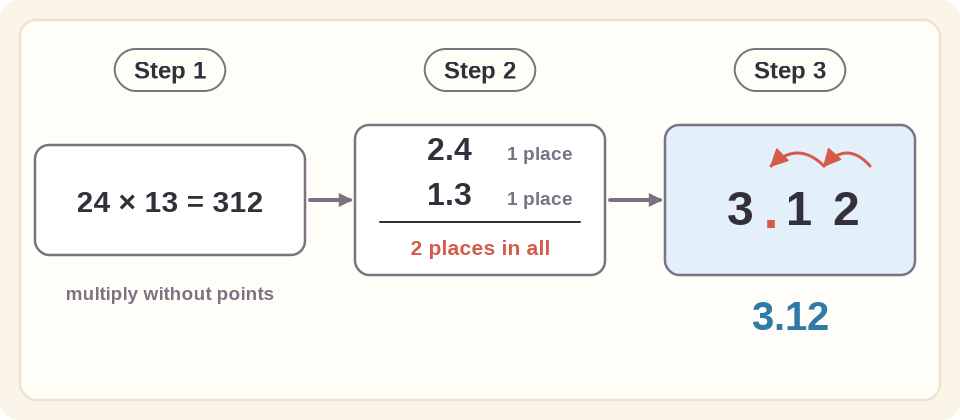
You know that 24 × 13 = 312. Can that help you find 2.4 × 1.3 without starting again?
Multiply, then place the point
Step 1: Multiply as if there were no points: 24 × 13 = 312.
Step 2: Count the digits after the point in both factors. 2.4 has 1 and 1.3 has 1. That is 2 in all.
Step 3: The answer gets 2 digits after the point, counted from the right: 3.12.
Check with an estimate: 2.4 × 1.3 is about 2 × 1 = 2. 3.12 is close. 31.2 or 312 would be far off.
More examples
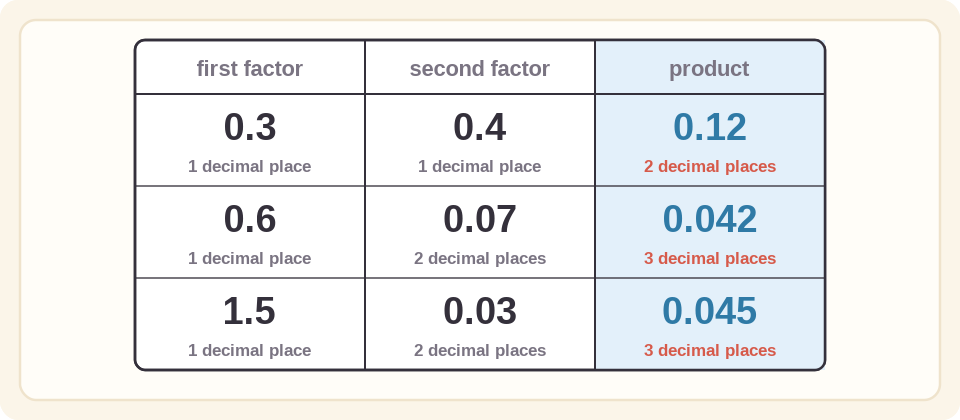
0.6 × 0.07: 6 × 7 = 42. The factors have 1 + 2 = 3 places, so 0.042.
1.5 × 0.03: 15 × 3 = 45. Again 3 places: 0.045. Write a zero to fill the empty place.
And a whole number times a decimal: 50 × 0.9 = 45.0, which is 45.
50 × 0.9 is less than 50, because 0.9 is less than 1.
Try it at home
- Choose two decimals, like 1.2 and 0.4.
- Multiply them without the points, then place the point by counting.
- Check with a calculator, and with an estimate.
Words in this lesson
- decimal place - a place after the decimal point: tenths, hundredths, thousandths.
Big idea
Multiply without the points, then give the answer as many decimal places as both factors have together.