When the Guess Is Too Big or Too Small
When you divide by a two-digit number, your first guess isn't always right. That's fine. You test it and fix it.
Too big: try one less
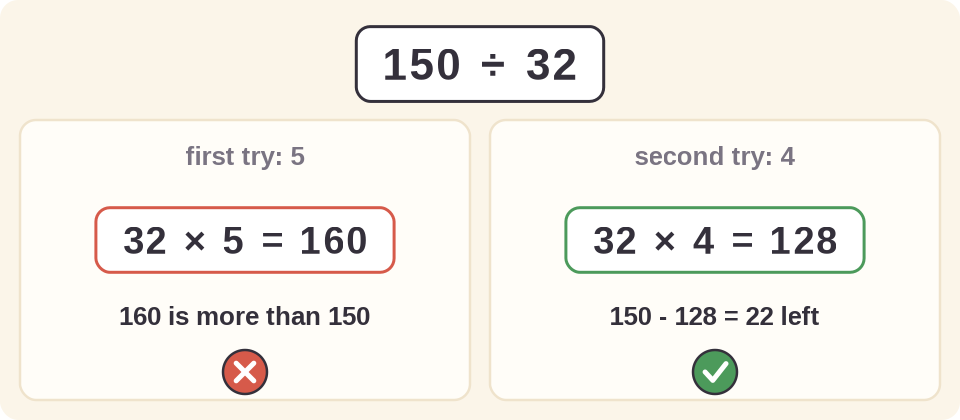
Leo works out 150 ÷ 32. 32 is close to 30, and 150 ÷ 30 = 5. So he guesses 5.
He tests it: 32 × 5 = 160. But 160 is more than 150! The guess is too big.
He tries one less: 32 × 4 = 128. 150 - 128 = 22 left. So 150 ÷ 32 = 4, with 22 left over.
Too small: try one more
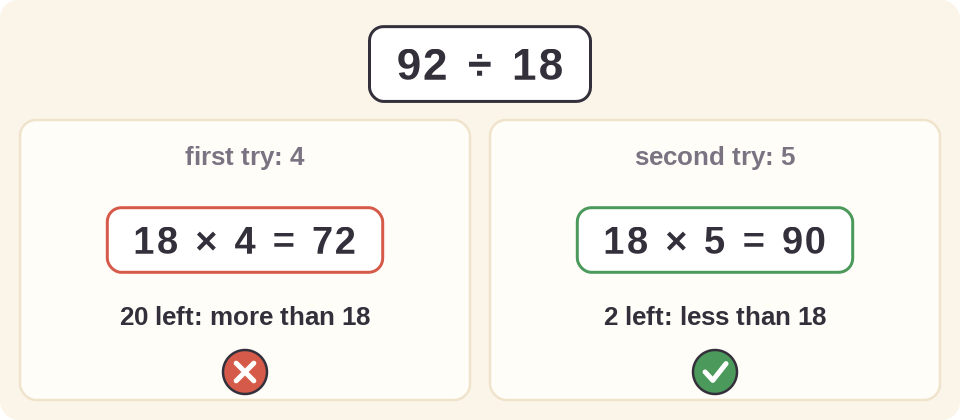
Aisha works out 92 ÷ 18. 18 is close to 20, and 80 ÷ 20 = 4. So she guesses 4.
She tests it: 18 × 4 = 72, and 92 - 72 = 20 left.
But 20 is more than 18. Another 18 still fits! The guess is too small.
She tries one more: 18 × 5 = 90. 92 - 90 = 2 left. Now the remainder is smaller than 18, so 5 is right.
Try it at home
- Work out 200 ÷ 45 on paper.
- Make a guess, then test it by multiplying.
- Is your remainder smaller than 45? If not, fix the guess.
Words in this lesson
- remainder - what is left over when a number can't be shared equally.
Big idea
If the product is too big, try one less; if the remainder is not smaller than the divisor, try one more.