The Standard Way to Multiply
A theater has 36 rows. Each row has 243 seats. How many seats are there? There is a short, neat way to write this.
A row for each digit
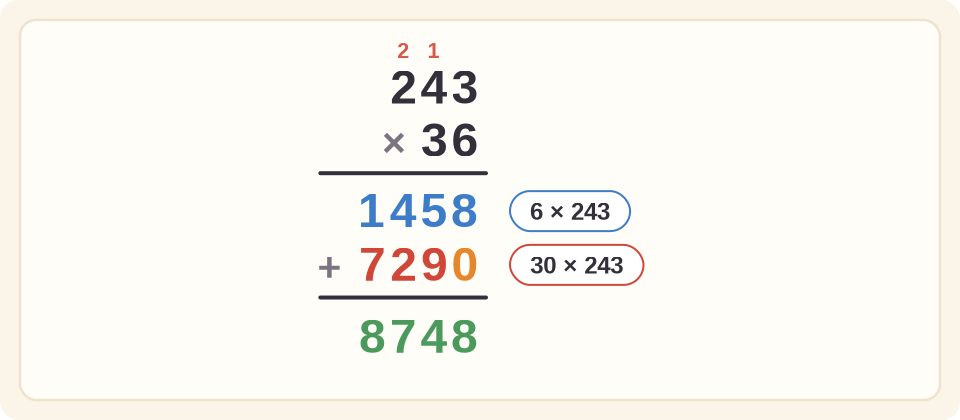
Write 243 above 36, with the ones lined up.
First multiply by the 6 ones: 243 × 6 = 1,458. Carry as you go, like in adding.
Then multiply by the 3 tens, which is 30. Write a 0 in the ones place first, then 243 × 3 next to it: 7,290.
Add the two rows: 1,458 + 7,290 = 8,748 seats. This is the standard algorithm.
Check with round numbers: 250 × 40 = 10,000 and 200 × 30 = 6,000. 8,748 is between them.
Three digits times three digits
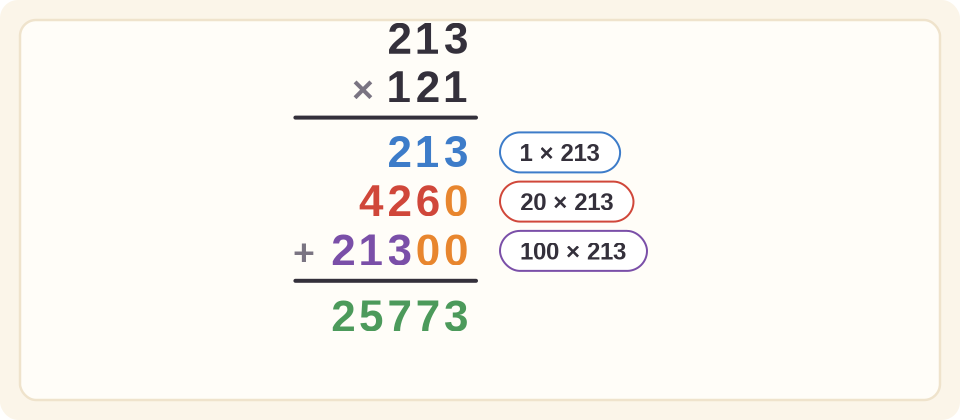
213 × 121 needs three rows, one for each digit of 121.
213 × 1 = 213. 213 × 20 = 4,260. 213 × 100 = 21,300.
Add them: 213 + 4,260 + 21,300 = 25,773.
Each new row starts with one more zero, because each digit of 121 is worth ten times more.
Try it at home
- Find how many days are in 12 years: 365 × 12.
- Write it in columns, a row for each digit of 12.
- Leap years add a few more days. Can you find how many?
Words in this lesson
- standard algorithm - the usual written way to work something out, step by step.
- partial product - one row of the work: the top number times one digit of the bottom.
Big idea
Multiply by each digit of the bottom number in its own row, then add the rows.