Base × Height
The floor of a box is 4 cm by 3 cm. Its volume is 36 cubic centimeters. How tall is the box?
The base is one layer
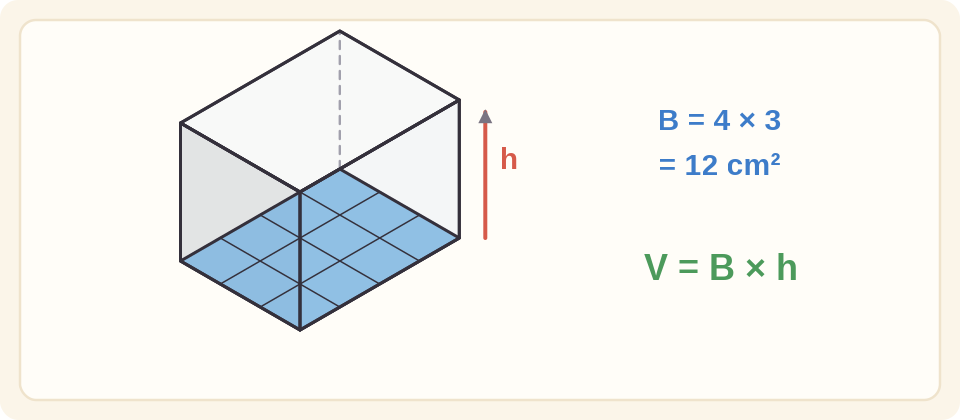
The bottom face of a box is called its base.
The area of the base is length × width. It tells how many cubes cover the floor: 4 × 3 = 12.
Every layer is the same as the base, and the height counts the layers.
So volume = area of the base × height. We write V = B × h, where B is the area of the base.
Finding a missing height
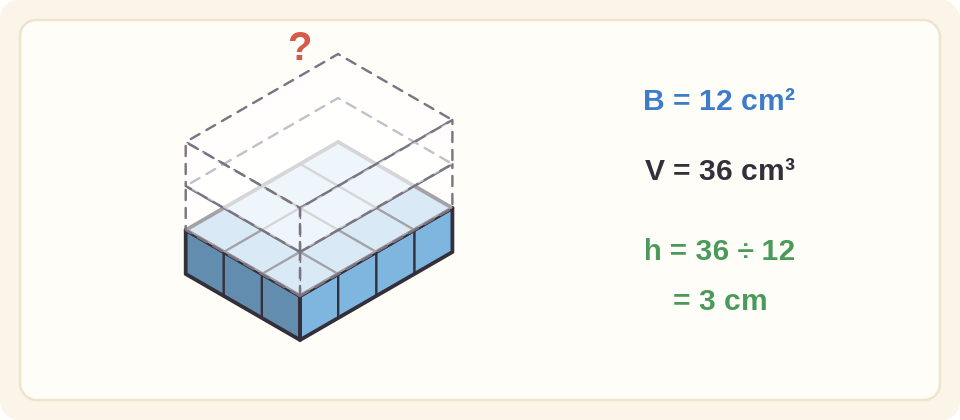
The base is 12 square centimeters and the volume is 36 cubic centimeters.
12 × h = 36. What number times 12 is 36? 36 ÷ 12 = 3.
So the box is 3 cm tall: 3 layers of 12 cubes.
It works the other way too. A box with a base of 20 square inches and a height of 5 inches has a volume of 20 × 5 = 100 cubic inches.
Try it at home
- Find a box and measure the length and width of its base.
- Work out the area of the base.
- Measure the height. Multiply to find the volume.
Words in this lesson
- base - the face a box stands on.
- area of the base - the number of square units that cover the base: length × width.
Big idea
Volume = area of the base × height; divide the volume by the base to find a missing height.