Length × Width × Height
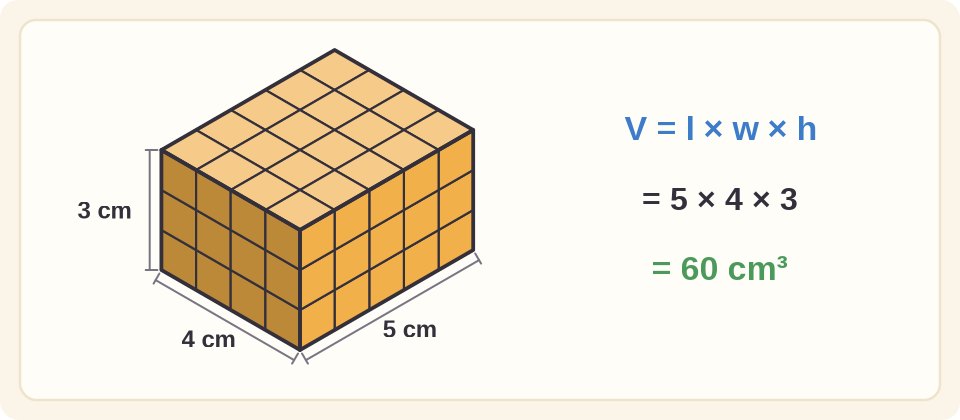
A box is 5 cm long, 4 cm wide and 3 cm high. You don't need to count 60 cubes one by one. There is a rule.
Multiply the three edges
One layer has length × width cubes: 5 × 4 = 20.
The height says how many layers: 3.
So the volume is length × width × height: 5 × 4 × 3 = 60 cubic centimeters.
We write V = l × w × h. V stands for volume, l for length, w for width and h for height.
Any order works
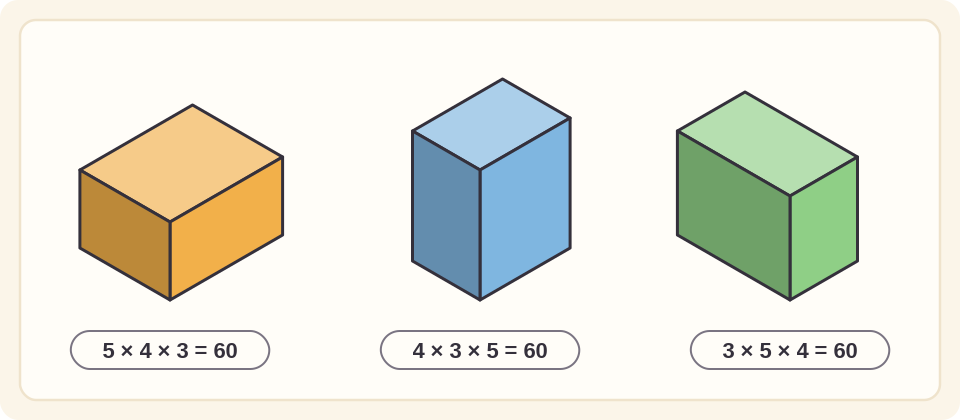
You can multiply the three numbers in any order. The volume is the same.
5 × 4 × 3: 20 × 3 = 60. Or 4 × 3 × 5: 12 × 5 = 60.
Pick an order that is easy. For 25 × 7 × 4, do 25 × 4 = 100 first, then 100 × 7 = 700.
A fish tank 50 cm long, 20 cm wide and 30 cm high holds 50 × 20 × 30 = 30,000 cubic centimeters.
Try it at home
- Find a cereal box or a shoe box.
- Measure its length, width and height in centimeters or inches.
- Multiply to find its volume. Write the units!
Words in this lesson
- length - how long a box is, along its bottom.
- width - how wide a box is, from front to back.
- height - how tall a box is.
Big idea
The volume of a box is length × width × height, in cubic units.