Simplifying Before Multiplying
What is × ? Multiplying gives , which is big and messy. There is a shortcut that keeps the numbers small.
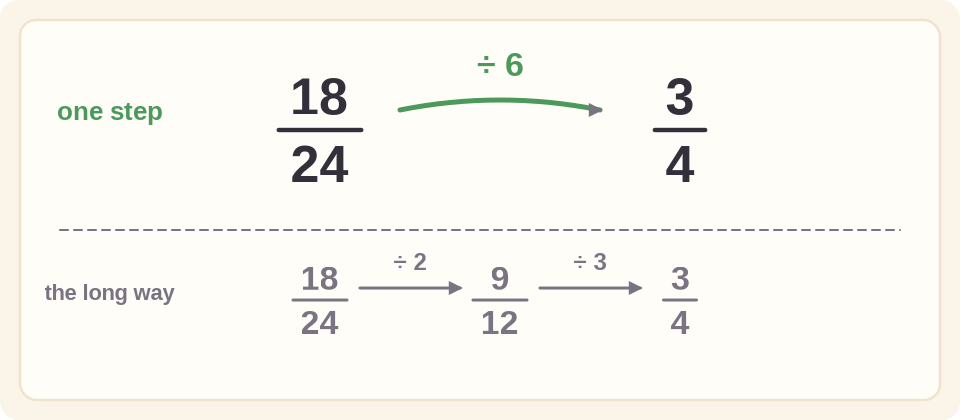
Simplify in one step
To simplify , you could divide by 2 to get , then by 3 to get .
Or find the biggest number that divides both 18 and 24. It is 6. Divide both by 6: = , in one step.
This biggest number is the greatest common factor.
Cancel before you multiply
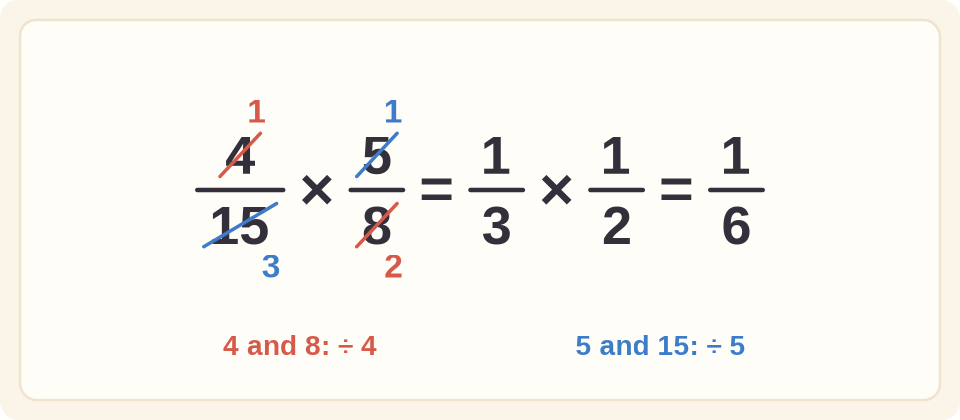
In × , a top and a bottom share a factor.
4 on top and 8 on the bottom: divide both by 4. They become 1 and 2.
5 on top and 15 on the bottom: divide both by 5. They become 1 and 3.
Now multiply: × = . This is called canceling.
Try it at home
- Write 12/16 on a card. Find the biggest number that divides 12 and 16.
- Simplify it in one step.
- Then try 3/8 × 4/9: cancel first, then multiply.
Words in this lesson
- greatest common factor - the biggest number that divides two numbers, like 6 for 18 and 24.
- cancel - to divide a top and a bottom by the same number before multiplying.
Big idea
Divide a top and a bottom by a shared factor before multiplying, and the numbers stay small.