Finding a Common Denominator
What is + ? Thirds and fourths are different pieces. Which piece size can both of them become?
Cut each one the other way
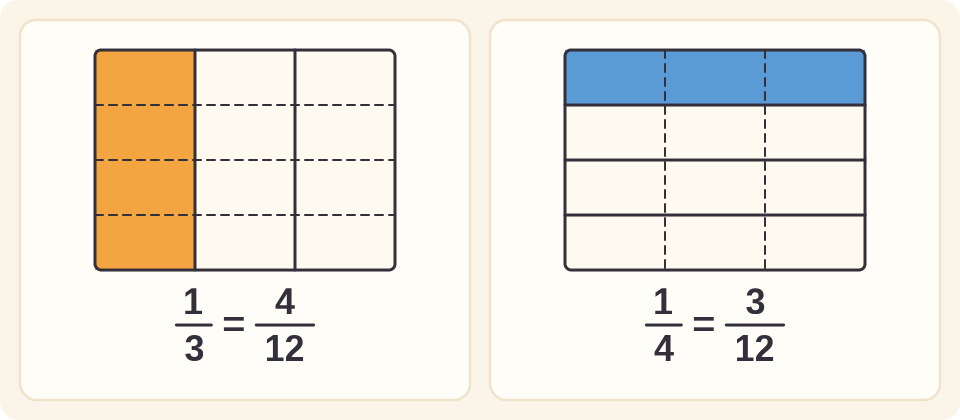
Draw a rectangle cut into 3 columns. Color 1 column: one third.
Now cut it into 4 rows too. There are 3 × 4 = 12 small parts, and 4 are colored. So = .
In the same way, one row of the 4 is .
+ = .
Multiplying the denominators always works
12 is 3 × 4. Multiplying the two denominators always gives a size both can become.
This shared bottom number is called a common denominator.
Multiply the top and bottom by the same number: = (times 4) and = (times 3).
A smaller one is neater
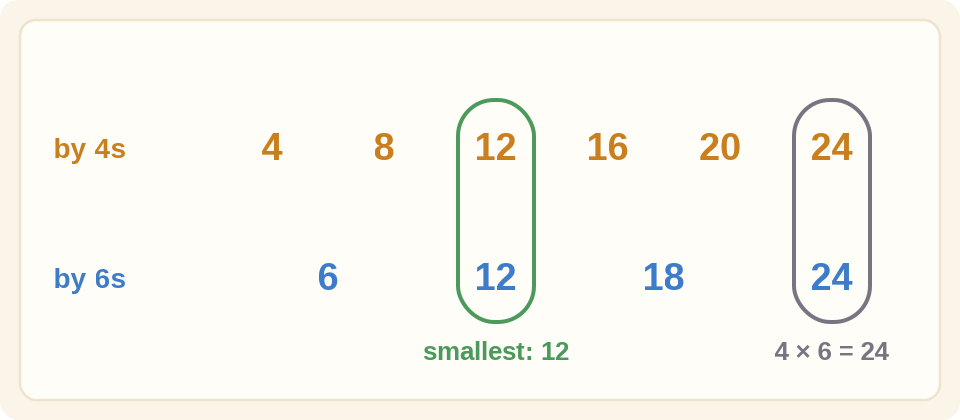
For + , 4 × 6 = 24 works. But count by 4s and by 6s: both reach 12 first.
+ = . With 24, you get , the same amount with bigger numbers.
Try it at home
- Fold a paper square in 3 one way and in 4 the other way.
- How many small parts are there?
- Color one third. How many twelfths did you color?
Words in this lesson
- common denominator - a bottom number that two fractions can both be changed to, like 12 for 1/3 and 1/4.
Big idea
Any common denominator works; the product of the denominators always does, and the smallest is the neatest.