Spinners and Area
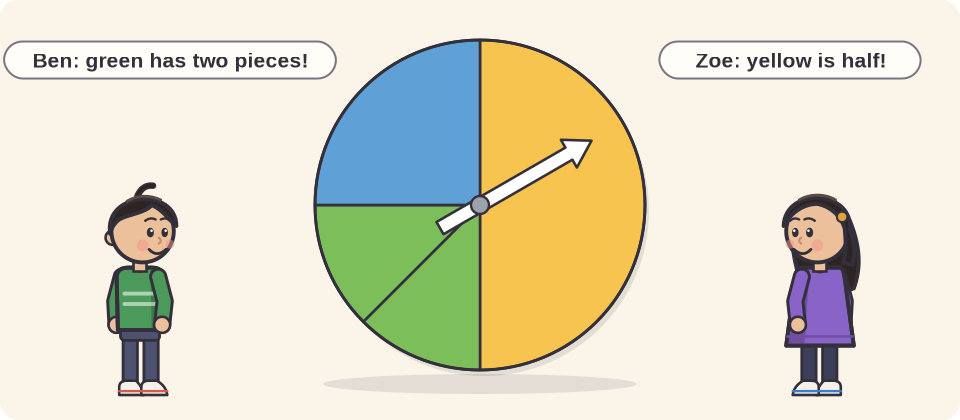
Ben and Zoe look at a spinner. Ben says: "Green has two pieces, so green will come most." Zoe says: "No, yellow will." Who is right?
Area, not pieces
The yellow piece is half the circle. The two green pieces together cover a quarter. The blue piece covers a quarter too.
The arrow can stop anywhere on the circle. The more of the circle a color covers, the more likely it is.
So Zoe is right: yellow is the most likely. Green and blue are equally likely.
Ten thousand spins
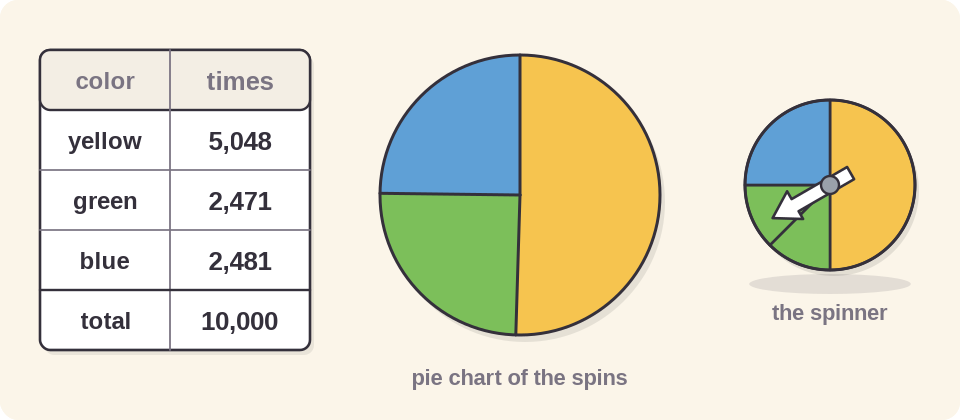
A computer spun this spinner 10,000 times. Yellow came 5,048 times, green 2,471 times and blue 2,481 times.
That is close to 5,000, 2,500 and 2,500: half, a quarter and a quarter.
With many spins, the results come out close to each color's share of the circle.
A die with pictures
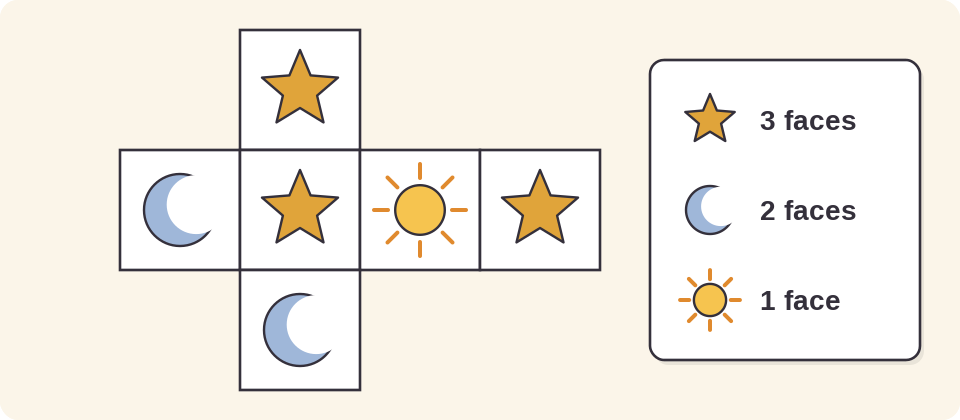
This die has pictures instead of dots: 3 stars, 2 moons and 1 sun.
Stars are on the most faces, so a star is the most likely. The sun is the least likely.
Try it at home
- Draw a circle on cardboard. Color half of it yellow, and split the other half into three small pieces of other colors.
- Hold a paper clip at the center with a pencil tip and spin it 20 times.
- Did yellow come about half the time?
Words in this lesson
- share - the part of the whole that belongs to one color.
Big idea
On a spinner, a color's chance depends on how much of the circle it covers, not on how many pieces it has.