Dividing by 10, 100 and 1,000
A factory makes 52,000 crayons. It puts them in packs of 10. How many packs is that? Dividing by 10 undoes multiplying by 10.
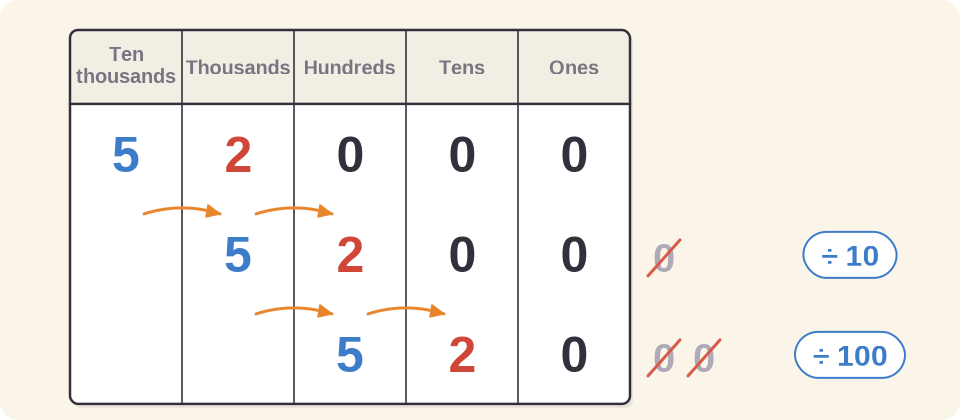
Every digit moves right
Dividing by 10 makes each place worth one tenth as much.
So every digit moves one place to the right. A zero at the end drops off: 52,000 ÷ 10 = 5,200 packs.
Dividing by 100 moves every digit two places: 52,000 ÷ 100 = 520.
Dividing by 1,000 moves them three places: 3,600,000 ÷ 1,000 = 3,600.
Dividing round numbers
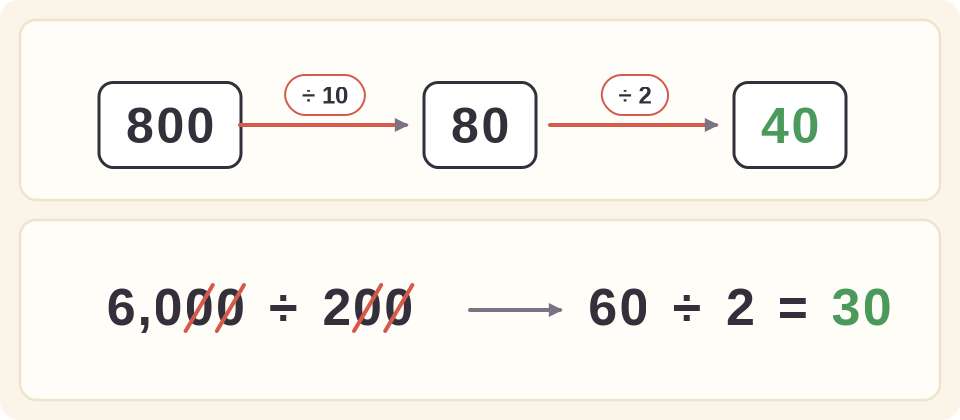
What is 800 ÷ 20? Do it in two steps.
20 is 10 × 2. So divide by 10 first: 800 ÷ 10 = 80. Then divide by 2: 80 ÷ 2 = 40.
Another way: take the same number of zeros off both numbers. 6,000 ÷ 200 becomes 60 ÷ 2 = 30.
Careful: take off the same number of zeros from each. 6,000 ÷ 200 is not 600 ÷ 2.
Try it at home
- Write 90,000 ÷ 300 on paper.
- Cross off two zeros from each number.
- What is left to divide? Check your answer by multiplying.
Words in this lesson
- quotient - the answer to a division.
Big idea
Dividing by 10, 100 or 1,000 moves every digit one, two or three places to the right.