Multiplying Numerators and Denominators
Drawing an area model takes time. Is there a quick way to work out × ?
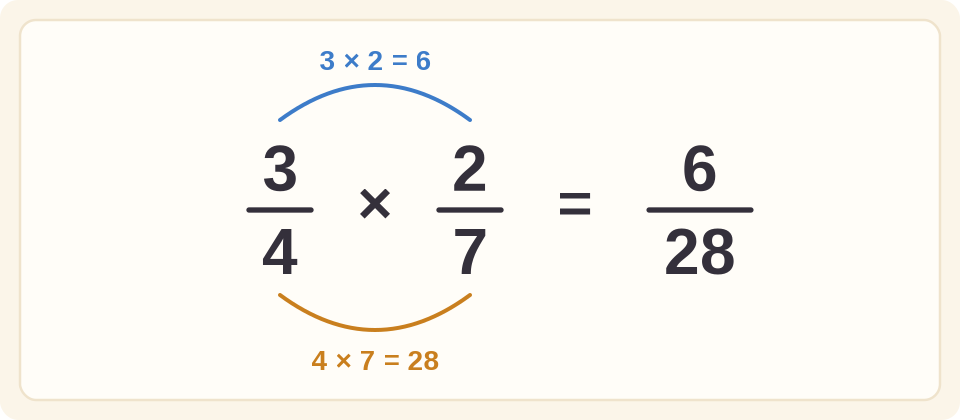
Tops times tops, bottoms times bottoms
In an area model, the bottoms make the rows and the columns. So bottom × bottom counts all the small parts.
The tops make the colored rows and the striped columns. So top × top counts the parts where they meet.
So × : 3 × 2 = 6 on top, 4 × 7 = 28 on the bottom. The product is .
The top of a fraction is its numerator. The bottom is its denominator.
The order doesn't matter
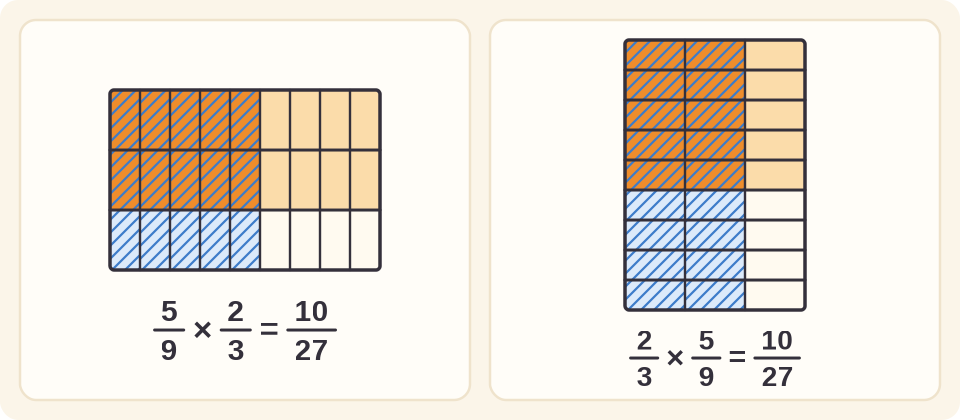
Is × the same as × ?
Yes! 2 × 5 = 5 × 2 and 3 × 9 = 9 × 3. Both are 10 twenty-sevenths.
In the area model, turning the rectangle on its side swaps the rows and the columns. The overlap stays the same size.
Try it at home
- Write three fractions on cards, like 1/2, 2/3 and 3/5.
- Multiply two of them: tops times tops, bottoms times bottoms.
- Swap their order and multiply again. Did you get the same answer?
Words in this lesson
- numerator - the top number of a fraction: how many parts are taken.
Big idea
To multiply fractions, multiply the numerators and multiply the denominators.