The Mean
Three friends built towers of blocks: 7, 3 and 5 blocks tall. If they shared the blocks so every tower was the same height, how tall would each tower be?
Leveling the towers
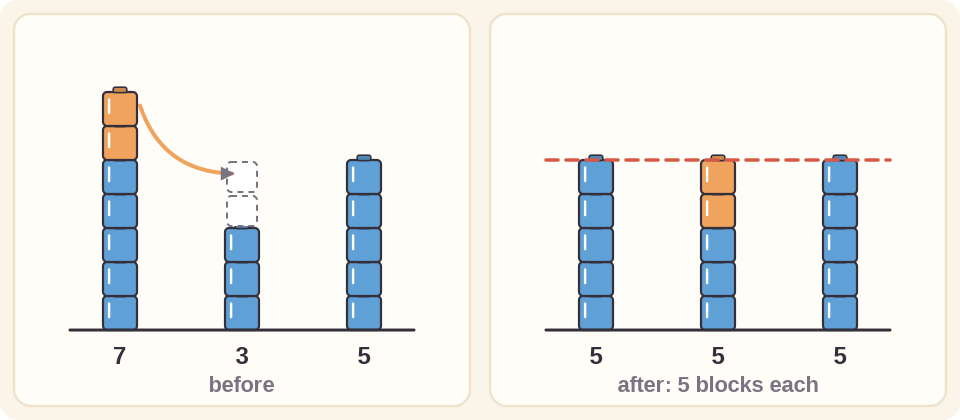
Move blocks from the tall towers to the short ones. Don't add any, and don't take any away.
Move 2 blocks from the 7 to the 3. Now all three towers are 5 blocks tall.
5 is the mean of 7, 3 and 5. Many people call it the average.
Add, then divide
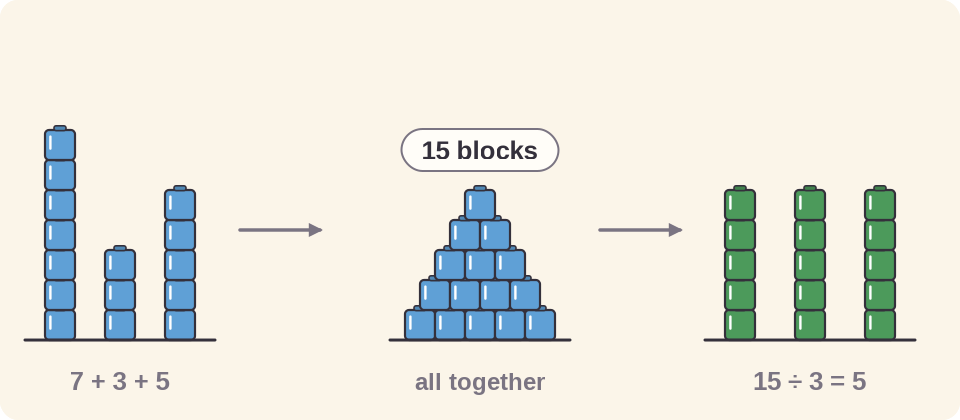
You don't need blocks. Add the numbers, then divide by how many numbers there are.
7 + 3 + 5 = 15, and 15 ÷ 3 = 5.
Five children read 4, 7, 5, 9 and 10 books. 4 + 7 + 5 + 9 + 10 = 35, and 35 ÷ 5 = 7. The mean is 7 books.
Why scientists measure more than once
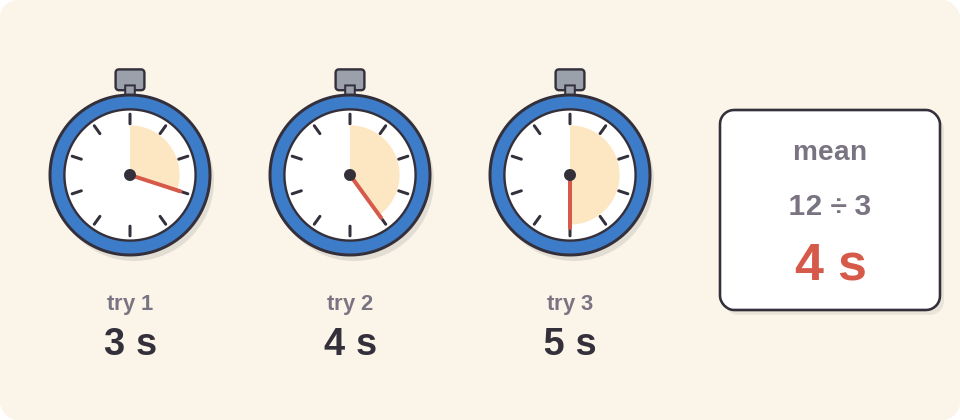
Grace times a paper spinner falling to the floor. She gets 3, 4 and 5 seconds.
One try can be a little off: a stopwatch pressed late, a ruler read crookedly.
The mean of several tries, 4 seconds, is more trustworthy than any one try.
But if one result is far from the others, like 10, 10 and 31, it is probably a mistake. Measure again!
Try it at home
- Build three towers of 2, 6 and 7 coins or blocks.
- Move coins until the towers are level. How tall is each?
- Check: add the three numbers and divide by 3.
Words in this lesson
- mean - the total shared out equally; add the numbers and divide by how many there are.
- average - another name for the mean.
Big idea
The mean is the total shared out equally: add the numbers and divide by how many there are.