Dividing Decimals by 10, 100 and 1,000
A stack of 10 notebooks is 45.6 millimeters tall. How thick is one notebook?
Every digit moves right
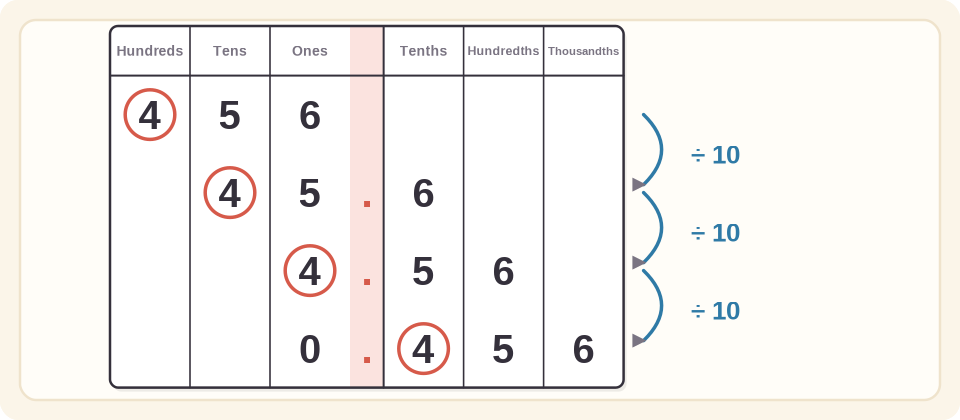
Dividing by 10 makes every digit worth ten times less.
So every digit moves one place to the right in the place-value table.
45.6 ÷ 10 = 4.56. One notebook is 4.56 millimeters thick.
Dividing by 100 moves the digits two places. Dividing by 1,000 moves them three.
Fill in the zeros
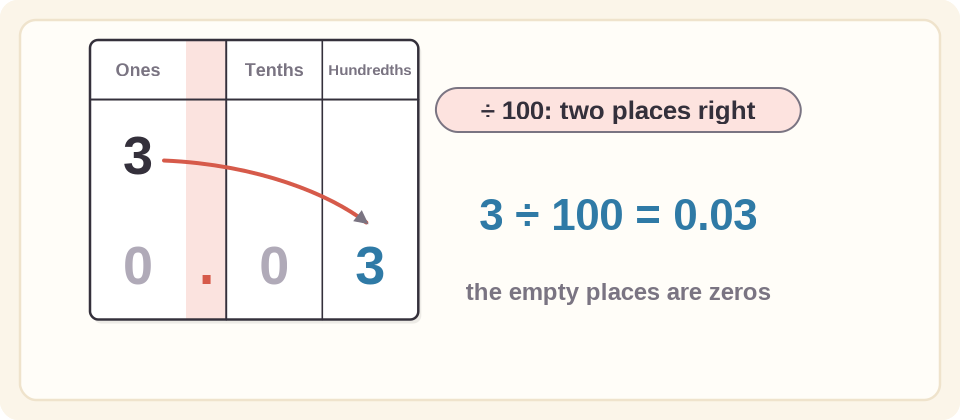
What is 3 ÷ 100? Write 3 as 3.0. Move the digits two places right.
The 3 lands in the hundredths. Fill the empty places with zeros: 0.03.
36.5 ÷ 100 = 0.365. And 250 ÷ 1,000 = 0.25.
Check by multiplying: 0.365 × 100 = 36.5. Multiplying moves the digits back.
Try it at home
- Find a pack of 10 or 100 things, like paper or napkins.
- Measure how tall or heavy the whole pack is.
- Divide by 10 or 100 to find one, by moving the digits.
Words in this lesson
- power of ten - 10, 100, 1,000 and so on: tens multiplied together.
Big idea
Dividing by 10, 100 or 1,000 moves every digit one, two or three places to the right.