Multiplying Fractions with an Area Model
A garden is one square. of it has vegetables. Mateo plants beans in of the vegetable part. What part of the garden has beans?
Rows for the first fraction
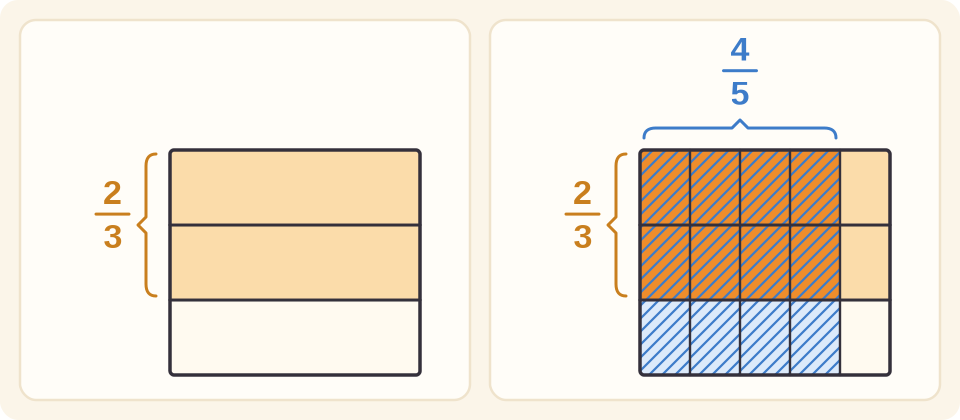
Cut the square into 3 rows and color 2 of them. That is the with vegetables.
Now cut it into 5 columns and stripe 4 of them. That is .
Where the color and the stripes meet is the beans.
Count the small parts
The square now has 3 × 5 = 15 small parts.
The beans fill 2 rows × 4 columns = 8 of them.
So of = × = .
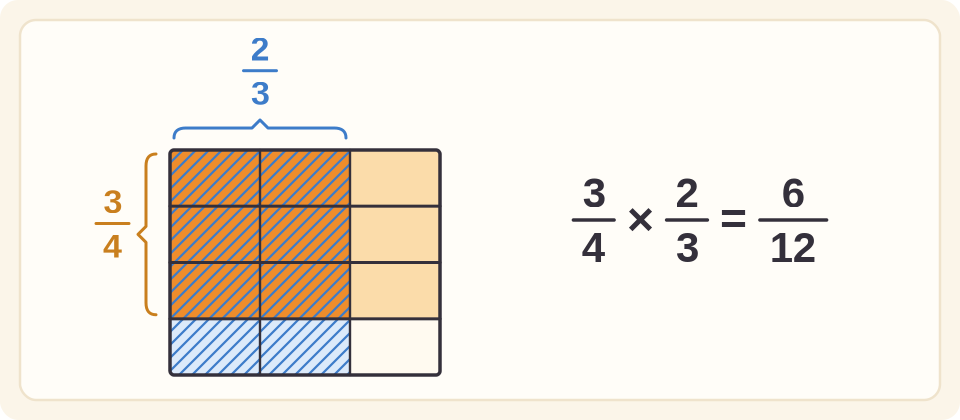
Try one more: × . 4 rows by 3 columns make 12 parts. 3 rows meet 2 columns in 6 parts: .
Try it at home
- Draw a square on grid paper, 4 squares by 4.
- Color 3 of the 4 rows. Then circle 1 of the 4 columns.
- How many small squares are colored and circled? What fraction of the square is that?
Words in this lesson
- area model - a rectangle cut into rows and columns to show a product.
Big idea
In the area model, one fraction cuts the rows, the other the columns; the overlap is the product.