Lining Up the Decimal Points
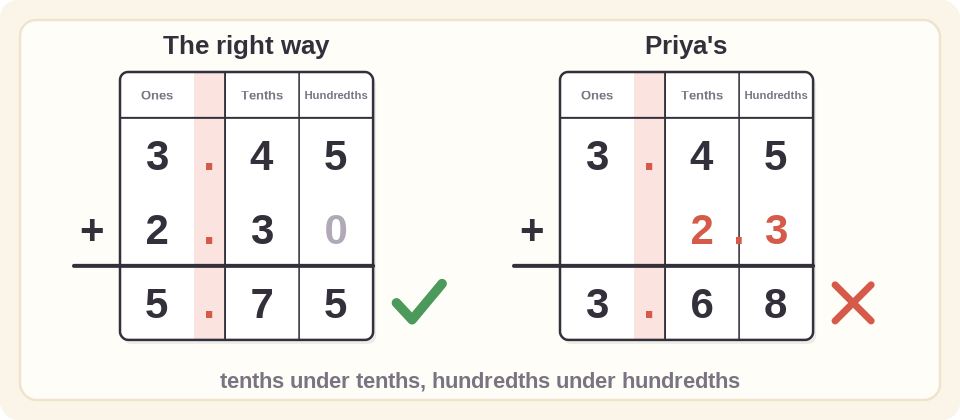
Priya adds 3.45 + 2.3. She writes the numbers one under the other and gets 3.68. That can't be right! What went wrong?
Point under point
Priya lined up the last digits, as with whole numbers. So 3 tenths ended up under 5 hundredths.
With decimals, put the decimal points in a straight line. Then tenths are under tenths and hundredths under hundredths.
An empty place is a zero: 2.3 is 2.30.
Now add each column, from the right: 3.45 + 2.30 = 5.75.
Carrying works the same
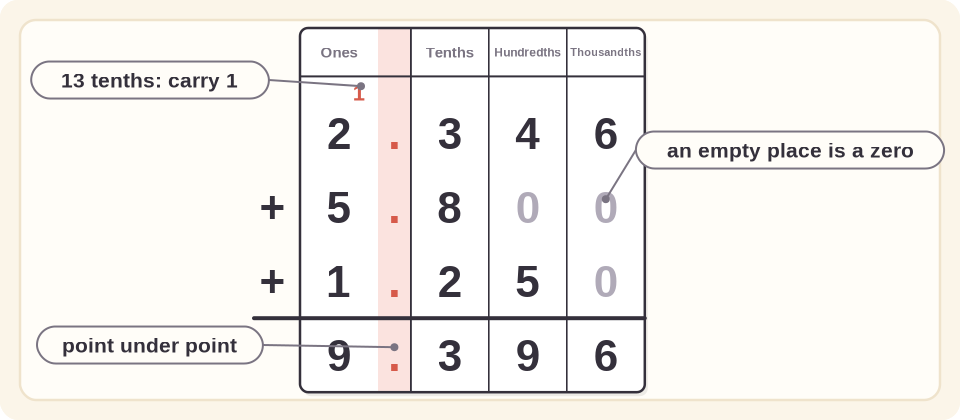
Add 2.346 + 5.8 + 1.25. Line up the points and fill the empty places with zeros.
Thousandths: 6. Hundredths: 4 + 5 = 9. Tenths: 3 + 8 + 2 = 13. Write 3 and carry 1 to the ones.
Ones: 1 + 2 + 5 + 1 = 9. The sum is 9.396.
Bring the point straight down into the answer.
Try it at home
- Find two prices on a receipt.
- Write them one under the other, point under point.
- Add them, then check with the receipt or a calculator.
Words in this lesson
- decimal point - the dot that separates the whole number from the parts.
Big idea
Line up the decimal points, write zeros in empty places, then add each column as with whole numbers.