Metric Conversions
A pencil is 12 centimeters long. How many millimeters is that? In the metric system, changing units is just moving digits.
Every step is 10, 100 or 1,000
Metric units are built with tens. The front of the name tells you how many.
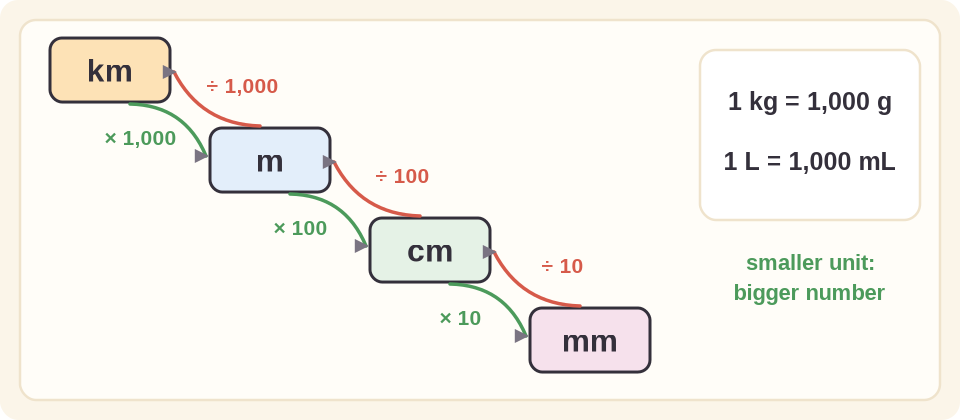
Kilo means 1,000: 1 km = 1,000 m and 1 kg = 1,000 g.
Centi means one hundredth: 1 m = 100 cm. Milli means one thousandth: 1 m = 1,000 mm, 1 L = 1,000 mL and 1 cm = 10 mm.
So the pencil is 12 × 10 = 120 mm.
Moving the decimal point
To change to a smaller unit, multiply. The number gets bigger, because it takes more small units to make the same length.
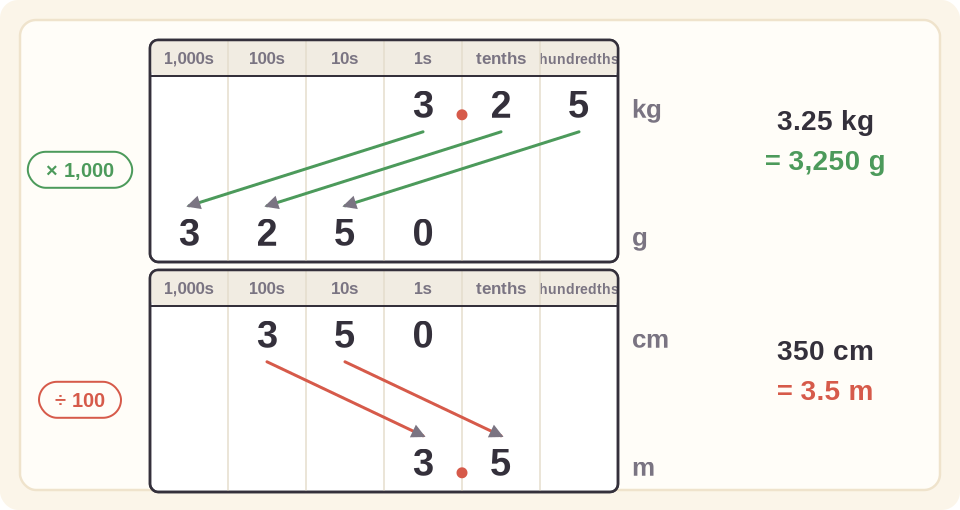
2.5 km = 2.5 × 1,000 = 2,500 m. 3.25 kg = 3.25 × 1,000 = 3,250 g.
To change to a bigger unit, divide. The number gets smaller.
350 cm = 350 ÷ 100 = 3.5 m. 750 mL = 750 ÷ 1,000 = 0.75 L.
Try it at home
- Find a ruler with centimeters and millimeters.
- Measure a spoon in centimeters. Change it to millimeters.
- Measure your room in meters, then change it to centimeters.
Words in this lesson
- convert - to write a measurement in another unit, like 3 m as 300 cm.
- milli - one thousandth: a millimeter is one thousandth of a meter.
Big idea
Metric units go up and down by 10, 100 and 1,000: a smaller unit means a bigger number.