Adding Two Dice
Eleven cars numbered 2 to 12 have a race. Roll two dice and add them: the car with that number moves one step. Is this race fair?
Count every pair
The first die can land 6 ways, and so can the second. That makes 6 × 6 = 36 different pairs.
This table shows the sum of every pair.
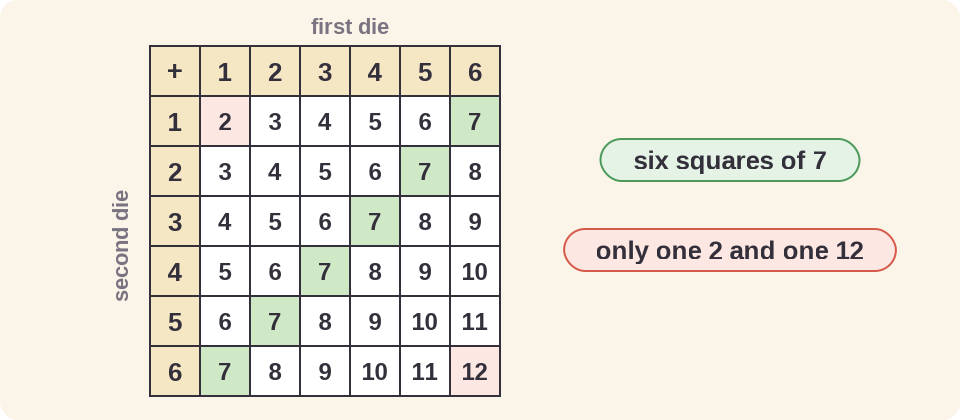
The sum 7 is in 6 squares: 1 and 6, 2 and 5, 3 and 4, and the other way round.
The sums 2 and 12 are in only one square each.
The race is not fair
If each of the 36 pairs came once, the cars would move like this.
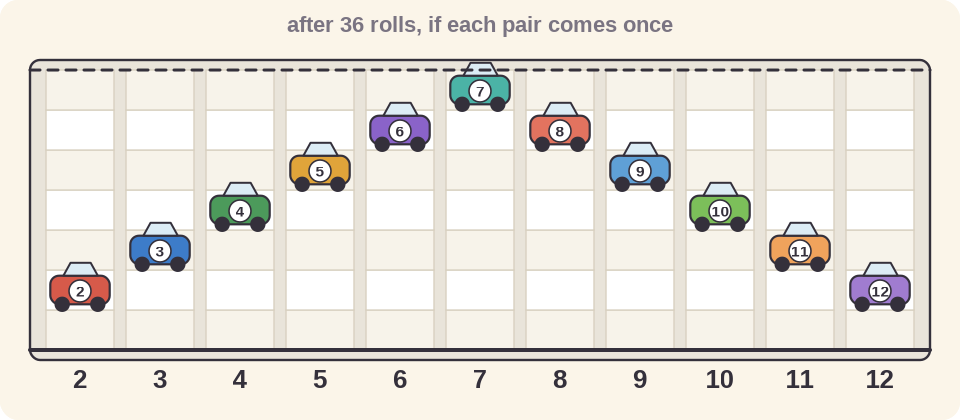
Car 7 goes furthest. Cars 2 and 12 hardly move. There is no car 1, because two dice always add up to at least 2.
Real dice won't come out exactly like this, but car 7 is usually ahead. The race is not fair.
Try it at home
- Roll two dice 36 times. Each time, make a tally mark beside their sum, from 2 to 12.
- Which sum came most often? Which came least?
- Compare your tallies with the table.
Words in this lesson
- pair - two numbers that come up together, like 3 on one die and 4 on the other.
Big idea
With two dice, 7 is the most likely sum and 2 and 12 the least likely, because more pairs make 7.