Estimating Products
A school hall has 19 rows of 31 chairs. About how many chairs is that? You don't need the exact number to know.
Round each number first
To round to the nearest ten, look at the ones digit. 5 or more rounds up, less than 5 rounds down.
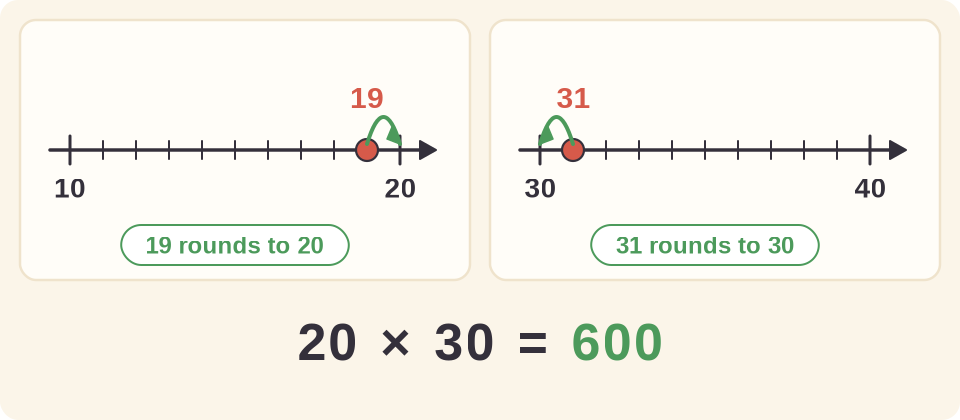
19 rounds to 20. 31 rounds to 30. A number like 65, exactly halfway, rounds up to 70.
Now multiply the round numbers: 20 × 30 = 600. So there are about 600 chairs.
The exact answer is 19 × 31 = 589. That is close to 600.
Bigger numbers, rounder numbers
With bigger numbers, round so each has just one digit that isn't zero.
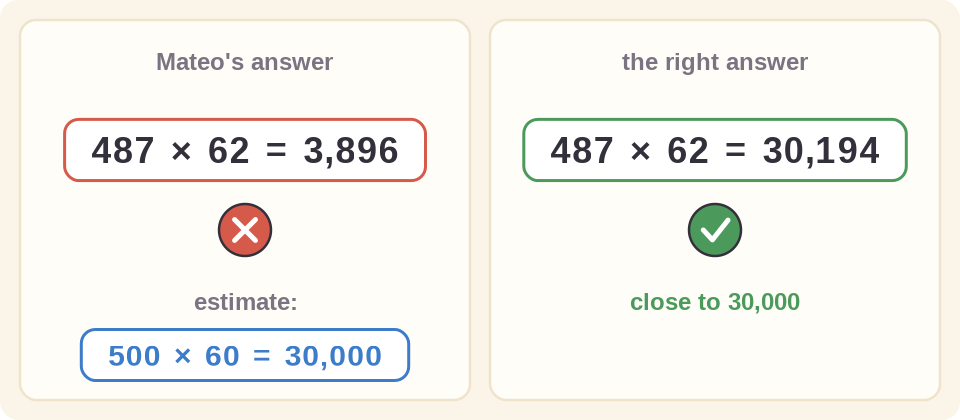
487 × 62: round 487 to 500 and 62 to 60. 500 × 60 = 30,000.
Mateo worked out 487 × 62 and got 3,896. His estimate says it should be about 30,000. So he made a mistake.
The real answer is 30,194. He forgot the 0 at the start of the second row.
Try it at home
- Count the steps from your bed to the door.
- About how many steps would 48 trips be? Round first.
- Use a calculator to see how close you were.
Words in this lesson
- estimate - an answer that is close, found with rounder numbers.
Big idea
Round each number before multiplying to get a quick estimate, and use it to check your answer.