When Shortcuts Go Wrong
Try this first
Look at the two lines below. Which one is longer, the top one or the bottom one?
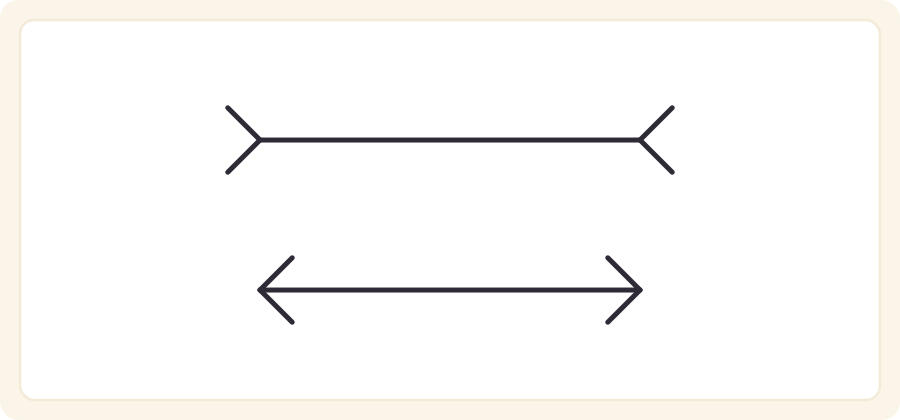
Almost everybody says the top one. It looks clearly longer. This picture was first drawn by the German scientist Franz Müller-Lyer in 1889, and it still fools nearly everyone who sees it for the first time.
Show the answer
The two lines are exactly the same length. Only the fins at their ends are different. Measure them with a ruler, or a piece of paper held against the screen, if you don't believe it.
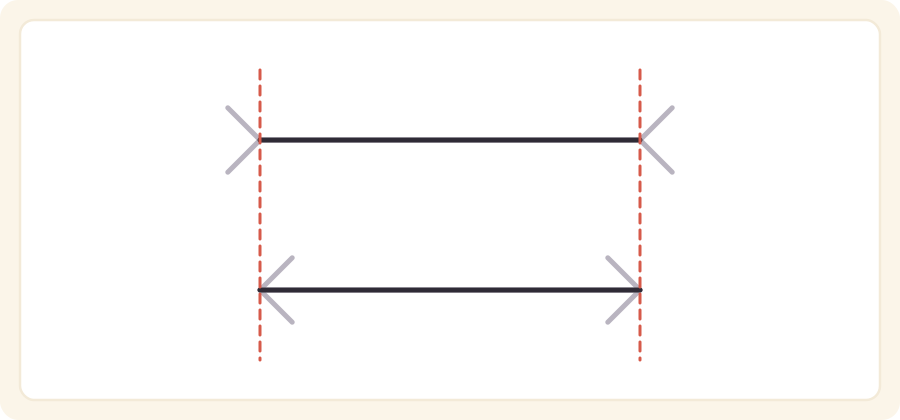
Now look at the first picture again. Does the top line still look longer? For almost everyone it does. Knowing the answer doesn't change what you see.
A mistake with a direction
In Shortcuts in the Mind we saw that fast thinking runs on quick rules of thumb, and that they usually work. Your eyes use shortcuts too. Scientists still debate exactly which one is at work here. One idea is that in everyday life, lines like these are the edges of corners and walls, which tell your eyes about distance and size. On a flat page, that rule misfires.
Notice what kind of mistake this is. It is not random: people don't guess the top line longer one day and shorter the next. Nearly everyone gets it wrong, and they all get it wrong in the same direction. Psychologists call this kind of mistake a bias. A cognitive bias is a mistake the mind makes in thinking (not only in seeing) in a predictable direction, again and again, in most people.
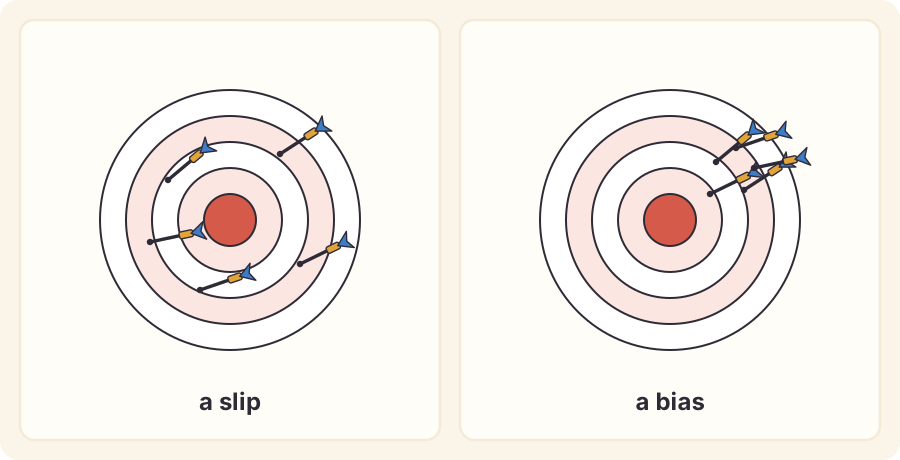
A bias is not stupidity, and it is not a careless slip. A slip is like a dart that misses in any direction. A bias is a dart that misses the same way every time, because the throw itself is pulled. Clever, careful people have biases too, because they have the same shortcuts.
Biases you may already know
You may have met two biases already. Confirmation bias: we notice what fits what we already believe and miss what doesn't. Anchoring: the first number we hear pulls our own guess towards it, even when it means nothing.
The rest of this course is a tour of others. In each lesson you will try a small task, see what most people did in a real study, and find the shortcut behind the mistake. Every one of them is a shortcut that usually helps, caught at the moment it misfires.
What helps
Like the lines, a bias doesn't switch off when you learn its name. What you can do is learn where it lives, and then use a ruler: something outside your head that doesn't share your shortcut. That might be writing a decision down, counting instead of guessing, or asking someone else.
Try it on a friend
- Draw the two lines with fins on a piece of paper, carefully the same length, and ask a friend which is longer.
- Measure them together with a ruler.
- Ask whether the top one still looks longer now. It almost always does.
Words to know
- bias - a mistake that always leans the same way
- cognitive bias - a mistake in thinking that most people make, again and again, in a predictable direction
Big idea
A cognitive bias is a shortcut misfiring in a predictable direction, in nearly everyone. Knowing about it doesn't make it go away, so use a ruler: something outside your head.