Back Towards Ordinary
Try this first
After a test, a teacher praises the five students with the best marks and has a stern word with the five with the worst. In the next test, the praised five do a little worse and the other five do a little better. The teacher decides: "Praise makes them lazy, and telling off works." Do you agree?
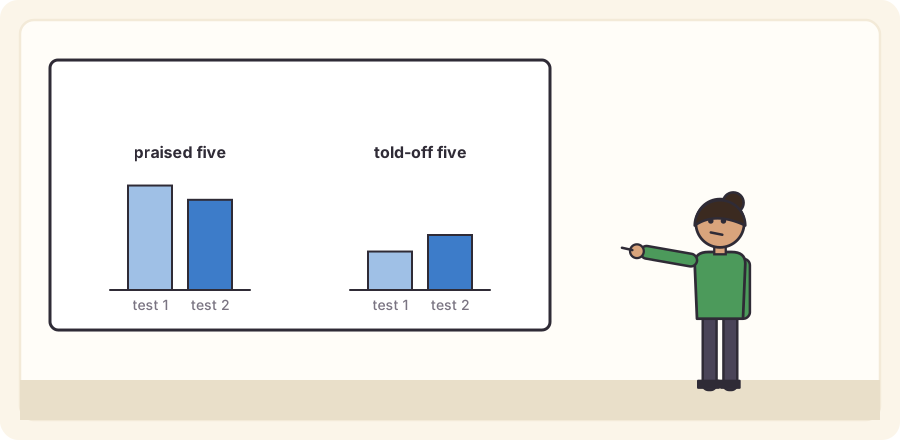
Most people think she has a point: the marks did move, just after she spoke. But marks move like this even when nobody says a word. Let's see why, one step at a time.
Two parts of every score
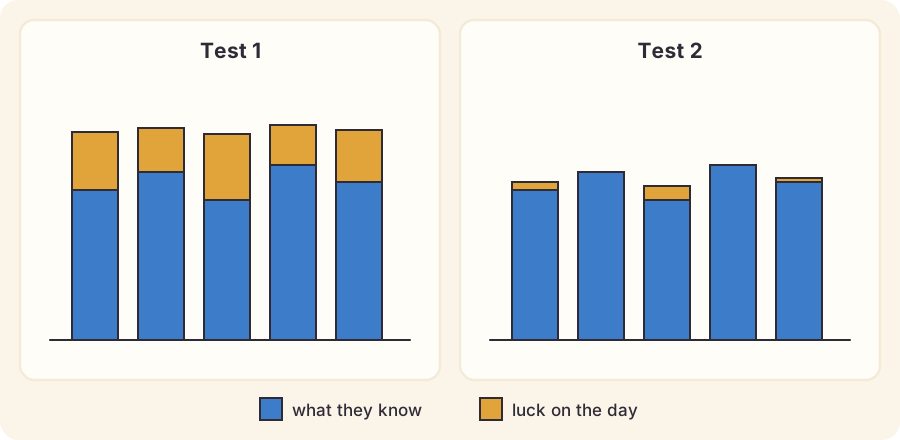
Step 1. Think of a test mark as two parts added together. One part is what you know. It stays much the same from week to week. The other part is luck on the day: which questions came up, a lucky guess. Luck is new every time.
Step 2. To get a top mark you need to know a lot, and usually to be lucky as well. So the top five are mostly good students who also had a lucky day.
Step 3. In the next test, they still know what they knew, but their luck is new. Most won't be that lucky twice. So, as a group, they score a little lower: still near the top, but lower than before.
Step 4. The bottom five are the same the other way round: mostly weaker students who also had an unlucky day. The bad luck doesn't come back, so they score a little higher.
Show the answer
No, the marks don't show that. They would have moved like this even if the teacher had said nothing. To learn whether praise works, she would have to compare praised students with similar students who weren't praised.
Its name
The average is the ordinary middle value: add up everyone's marks and share the total out equally. A result far from the average is usually followed by one closer to it, just by chance. This is called regression to the mean ("mean" is another word for average, and "regression" means going back).
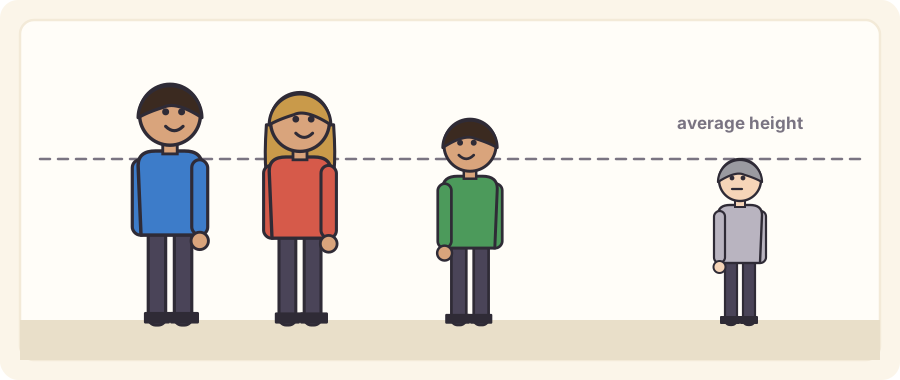
Francis Galton (1886) found it in people's height. Very tall parents usually had tall children, but on average a little less tall than themselves. Very short parents had short children, but on average a little less short.
Where it fools us
Daniel Kahneman once taught flight instructors. One told him: "When I praise a very smooth landing, the next one is worse. When I shout at a bad one, the next is better. So shouting works." The same mistake: a very smooth landing is partly luck, so the next is likely to be more ordinary anyway.
An athlete's best season ever puts them on a magazine cover, and a weaker season follows. People call it a curse, but it is mostly the same pull back. When a change follows something we did, it is easy to believe we caused it (see cause or coincidence).
What helps
When a very good or bad result is followed by a more ordinary one, ask: would it have moved back anyway? If luck played any part, it often would.
Catch it this week
Watch for something unusual followed by something ordinary: a second visit to a café that was amazing the first time, or a team's next match after a huge win. Ask how much luck was in the first one.
Words to know
- average - the ordinary middle value: add everything up and share it out equally
- regression to the mean - an unusually high or low result being followed by one closer to the average, just by chance
Big idea
Where luck plays a part, the unusual is usually followed by the more ordinary. Before you credit what happened in between, ask whether it would have moved back anyway.