The Invisible Gorilla
Try this first
In the picture below, count the white circles. Count carefully but quickly, in about ten seconds, and remember your number. Ignore the black shapes.
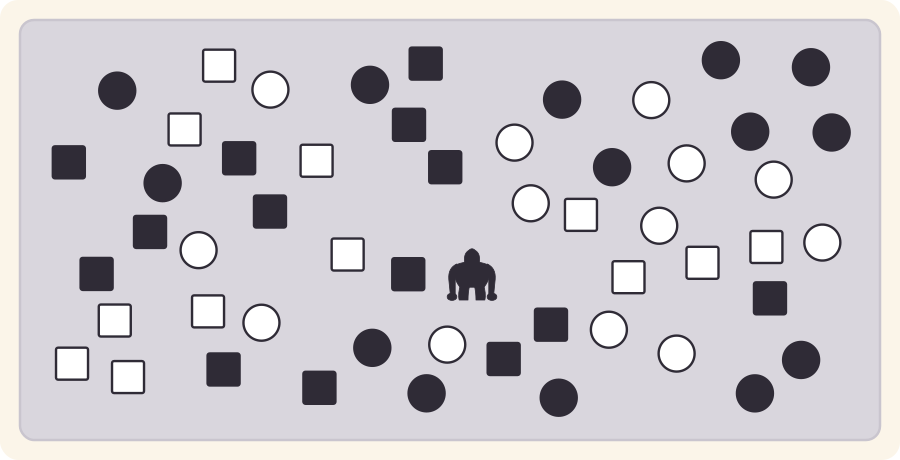
How many white circles did you count? Now a different question: did you notice the gorilla? Many people don't. If you didn't, go back and look at the picture again, this time without counting.
Show the answer
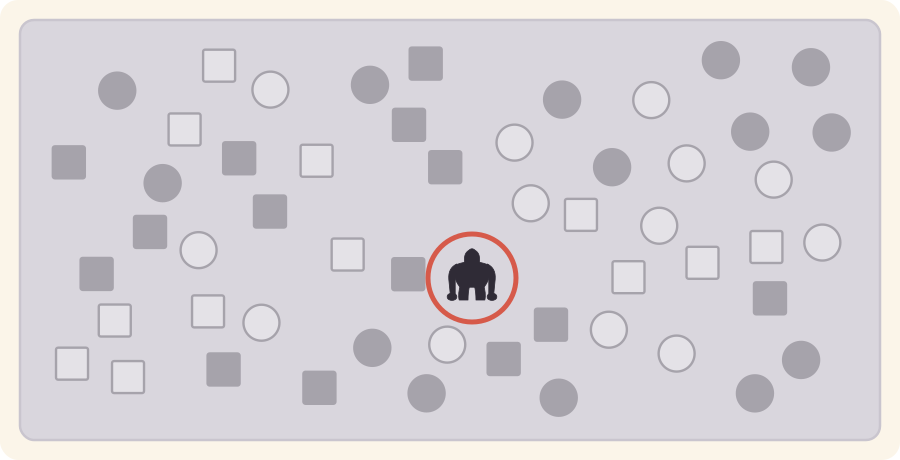
There are 13 white circles. And among the black shapes, near the middle, there is a small black gorilla, standing with its arms hanging down. It was there the whole time, as big as the other shapes.
The study
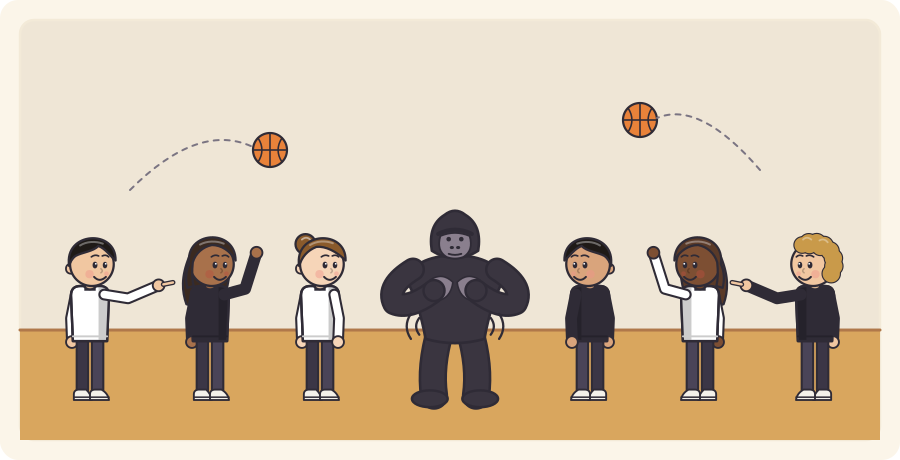
A picture on a page is a gentle version of a famous experiment. In 1999 two psychologists, Daniel Simons and Christopher Chabris, made a short film of six students passing two basketballs. Three wore white shirts and three wore black shirts. People watching it were asked to count the passes made by the white team.
Halfway through, a woman in a full gorilla suit walked into the middle of the players, turned to the camera, thumped her chest and walked off. She was on screen for several seconds. About half of the people counting the passes never saw her. When they were shown the film again, many could not believe it was the same film.
A spotlight, not a floodlight
Your eyes take in the whole scene, but your mind can only work on a small part of it at a time. So it chooses. When you count white circles, your mind turns up everything white and round and turns down everything else, including a black gorilla. This is selective attention: attending to what matters for the task and filtering out the rest. Missing something in plain sight because your attention is busy has its own name: inattentional blindness.
Selective attention is usually a gift. It is what lets you hear your friend in a noisy café, or read this sentence while traffic goes past outside. Attention works like a spotlight: a bright circle where you point it, and darkness around it. It is not a floodlight that lights up everything at once. Most of the time the darkness holds nothing important.
Where it shows up
You are looking for a blue car to pick you up, and you walk straight past your friend waving at you from the pavement. You are searching the fridge for the milk and don't see the jam you wanted next. A driver busy with a phone call, even with both hands on the wheel, misses a cyclist who was in full view.
What helps
- When something matters, look a second time with a different question: not "where is the thing I want?" but "what else is here?"
- When you drive, cycle or cross a road, put the phone away. Your eyes may be on the road while your attention isn't.
Try it on a friend
- Show a friend the picture of shapes at the top of this lesson and ask them to count the white circles.
- When they give you a number, ask whether they saw anything unusual.
- Show them the answer, and tell them they are in very good company.
Words to know
- selective attention - attending to what matters for the task and filtering out everything else
- inattentional blindness - missing something in plain sight because your attention is busy with something else
Big idea
Attention is a spotlight. We see what we are looking for and can miss what we aren't, even a gorilla. When it matters, look again with a different question.