It Will Only Take an Hour
Try this first
Think of one job you need to do soon: tidying a room, a piece of homework, a form, a small repair. How long will it take you? Write the time down, and keep the note until the job is done.
Most people write a number that feels honest. And most people, when they check later, find that the job took longer. This happens even to people who know that their last job ran late. Why don't we learn?
The students who knew better
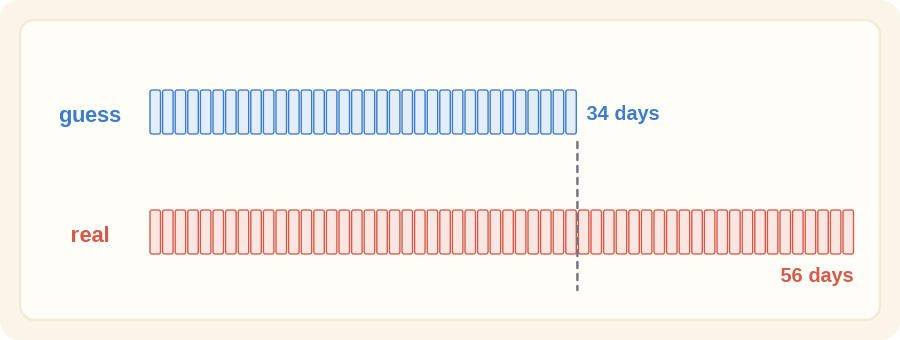
In 1994 Roger Buehler, Dale Griffin and Michael Ross asked university students in Canada who were writing a big final project: how many days will it take you to finish? Taken together, the students guessed about 34 days. In fact the projects took about 56 days. Fewer than a third of the students finished by the day they had named.
The researchers also asked for a guess "if everything goes as badly as it possibly can". Even that guess was too short for many students: more than half of them finished after the worst day they had imagined.
Daniel Kahneman and Amos Tversky gave this a name back in 1979: the planning fallacy. A fallacy is a mistake in thinking. This one is believing that our own plan will go as planned, when plans like it seldom do.
Why the mind does it
When we plan, we picture the job from the inside, step by step: first this, then that, then done. Each step in the picture goes smoothly. What we don't picture are the things that are not part of the plan: a cold, a friend who needs help, a missing part, a file that won't open. Each one is unlikely on its own. But some of them almost always happen.
The students in the study knew that their past projects had run late. When asked, they explained it away: last time was special. This time, the plan felt real.
Not only for students
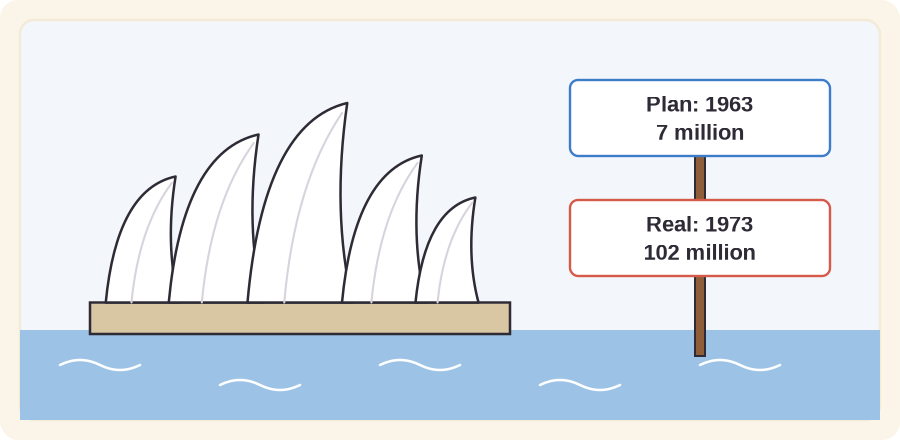
The same thing happens to big projects run by experts. The Sydney Opera House in Australia was planned to open in 1963 and to cost about 7 million Australian dollars. It opened in 1973 and cost about 102 million: ten years late and more than fourteen times the cost.
Kitchens, weddings, school plays and new roads run late in the same way.
What helps
- Take the outside view. Instead of picturing your own plan, ask: how long did jobs like this one really take, for me or for other people? That number is the outside view, and it is usually better than the plan.
- Write down your guesses and check them. After a few jobs you will know how much to add.
Try it on a friend
- Ask a friend how long a job they are about to do will take, and write it down.
- Then ask: "How long did it take the last time?" Most people find the second number is bigger, and many change their first guess.
- Check your own note from the start of this lesson when your job is done.
Words to know
- planning fallacy - expecting our own jobs to take less time and money than they do, even when similar jobs ran late
- outside view - judging a plan by how long similar jobs really took
Big idea
Our plans picture the steps, not the delays, so they run late. Ask how long similar jobs really took, and trust that number more than the plan.