Better Than Most
Try this first
Are you a better driver than most people your age? If you don't drive, are you a better listener than most of your friends? Answer yes or no before you read on.
If you said yes, you are in good company - most readers do. But think about it. Only half of a group can be in the better half. So when nearly everyone in a room says "better than most", some of them must be wrong. Why does this happen, and to whom?
The drivers who were all above the middle
In 1981 the psychologist Ola Svenson asked students in the United States and in Sweden a simple question: compared with the other students in this room, how safe a driver are you? Picture everyone lined up from the least safe to the safest. Where do you stand in the line?
About 9 in 10 of the American students put themselves in the safer half. About 7 in 10 of the Swedish students did the same. But the safer half of a line holds exactly half of the people in it. Many students had moved themselves up the line.
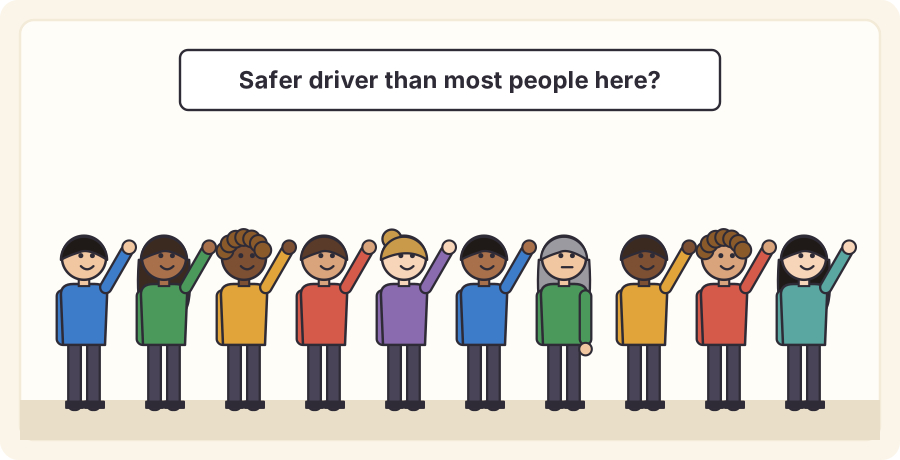
This pull towards "a bit better than the others" is called the better-than-average effect: most people rate themselves above the person in the middle, for skills and good qualities. It is one part of overconfidence, being more sure of ourselves than the facts allow. Later studies found it for being kind, being honest, getting along with others and being a good friend.
Why the mind does it
We see our own effort from the inside. We remember the times we braked in time and forget the times we were lucky. Other drivers we only see from the outside, and we notice their mistakes. Each of us also counts the skills we care about: one person thinks a good driver is careful, another thinks a good driver is quick. Both can feel they are better than most.
A warm view of ourselves also gives us the courage to try things and to keep going after a bad day. So this is a shortcut with a use - it only misfires when we bet on it.
Not for everything
The effect has a clear limit. When a skill is hard and we know it, people often rate themselves below the middle. Asked about juggling, or writing computer programs, most people say they are worse than most. They know they can't do it, and forget that most other people can't either.
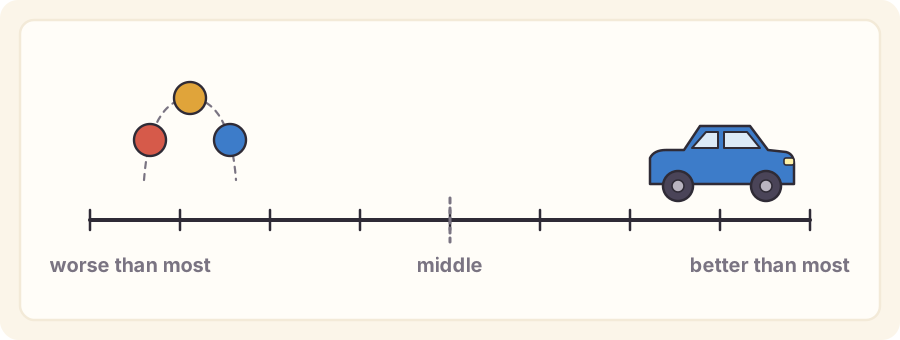
So the effect is not "everyone thinks they are great". It is that we judge ourselves on easy, everyday skills too kindly. How sure we should be is its own question: see degrees of confidence.
What helps
- Look for a score, not a feeling. A driving record, a test result or a friend's honest opinion tells you more than your sense of how good you are.
- When it matters, plan as if you were in the middle. Leave the same safe distance that you would want a stranger to leave.
Try it on a friend
- Ask three or four friends, one by one: "Out of 10 people your age, how many are better cooks than you?" (or better at keeping secrets, or at being on time).
- Add up the answers. If most of them say "fewer than 5", you have found the effect.
Words to know
- better-than-average effect - most people rating themselves above the middle of their group, for everyday skills and good qualities
- overconfidence - being more sure of ourselves than the facts allow
Big idea
Most people think they are better than most, which can't be true for everyone. Trust a score more than a feeling, and when it matters, plan as if you were in the middle.