Fast and Slow
Try this first
Answer in your head, quickly, before you read on. A bat and a ball cost 1.10 dollars together. The bat costs 1.00 dollar more than the ball. How much does the ball cost?
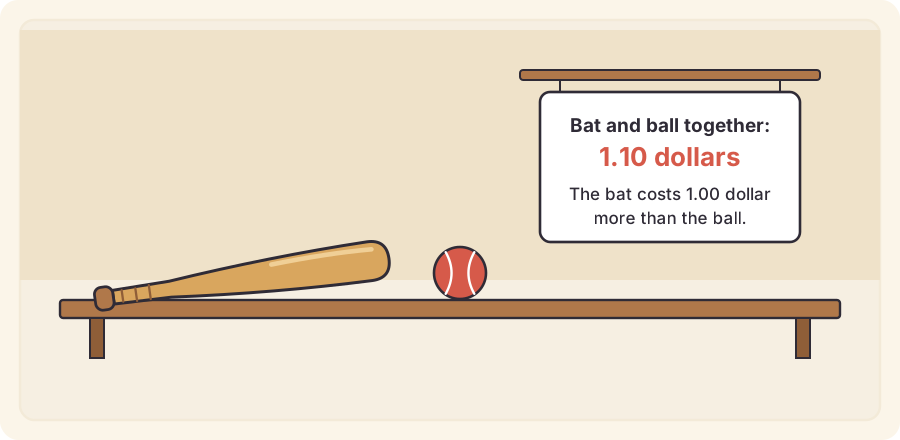
Did an answer jump into your head straight away? For most people it is 10 cents. It feels obvious. In 2005 a researcher called Shane Frederick asked this question to thousands of students. At some of the best universities in the United States, about half of them gave the quick answer. Here is why so many clever people say it.
This course is about psychology, the science of how people think, feel and act. A psychologist studies it, often with experiments: small tests that researchers set up to see what most people do. Every lesson here starts with a task like the bat and ball. Do it before you read on, because in this course the experiment is you.
Two kinds of thinking
Some thinking happens by itself. You see the word STOP and you have read it before you decide to. You know that 2 + 2 is 4 without working it out. You glance at a face and see at once that the person is angry. This is fast thinking: quick, automatic, and it takes no effort.
Other thinking is work. Try 17 × 24 in your head. You have to hold numbers, take steps, and keep going. Parking a car in a tight space is like that too. This is slow thinking: careful, step by step, and tiring.
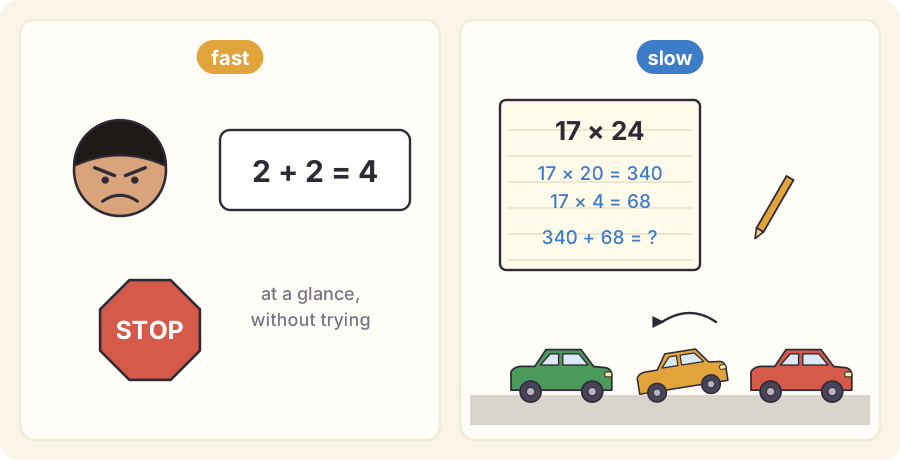
The psychologist Daniel Kahneman made these two ideas famous in his book Thinking, Fast and Slow (2011). Two other researchers, Keith Stanovich and Richard West (2000), had named them System 1 (fast) and System 2 (slow).
The lazy checker
Now back to the bat and ball. Fast thinking saw 1.10 and 1.00 and offered 10 cents. Slow thinking could have checked it, but it did not, because the answer felt right.
Show the answer
The ball costs 5 cents. Check 10 cents first: then the bat costs 1.00 dollar more, which is 1.10 dollars, and together they cost 1.20 dollars, not 1.10. With a ball of 5 cents, the bat costs 1.05 dollars, and together they cost 1.10 dollars.
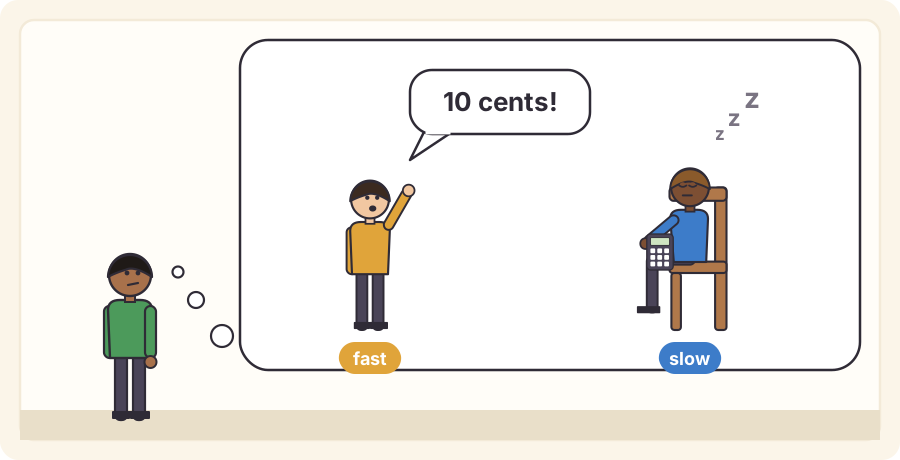
This is the most important idea in the course. Fast thinking is right most of the time. It lets you read, talk, walk and drive without thinking about each step. But slow thinking is lazy: it usually accepts whatever fast thinking offers, unless something makes it stop and check. Most of the tricks in the lessons ahead happen right there, when a quick answer feels right and nobody checks it.
What helps
When an answer arrives easily and the question matters, check it once. Put the answer back into the question: if the ball costs 10 cents, does the whole thing add up? That one step is often all slow thinking needs to wake up.
Try it on a friend
- Ask a friend or someone in your family the bat and ball question, and ask for a quick answer.
- If they say 10 cents, ask them to check it by adding up the two prices.
- Tell them that about half of the students at top universities said 10 cents too. Nobody should feel silly.
Words to know
- psychology - the science of how people think, feel and act
- fast thinking (System 1) - thinking that happens by itself, quickly and without effort
- slow thinking (System 2) - careful, step-by-step thinking that takes effort
Big idea
Your mind thinks in two ways, fast and slow. Fast thinking is usually right, but slow thinking rarely checks it. When it matters, check the quick answer once.