Shortcuts in the Mind
Try this first
Two cities in the United States, San Diego and San Antonio. Which one has more people? Don't look it up: pick one in a second.
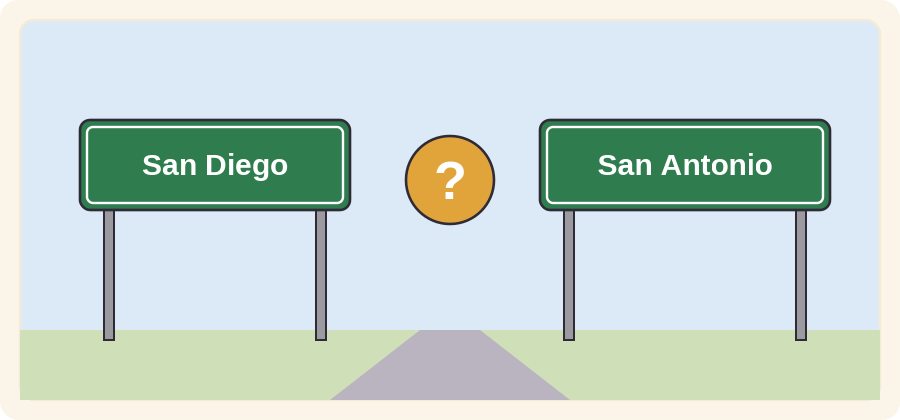
Which did you pick, and how? If you live outside the United States, there's a good chance you have heard of San Diego and never heard of San Antonio. Then the choice was easy: you picked the one you knew. It took no counting and no facts. Was that a silly way to choose, or a clever one?
The study
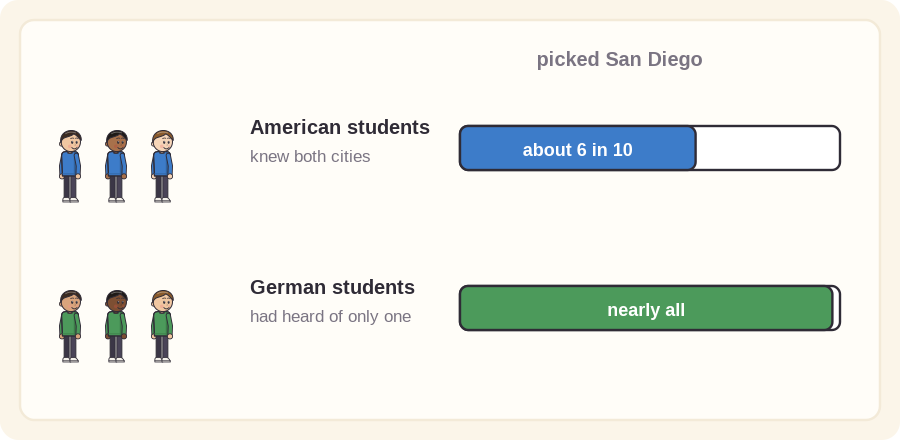
In 2002 two researchers, Daniel Goldstein and Gerd Gigerenzer, asked this very question to students in two countries. They used cities whose sizes were known at the time of the study, and then San Diego had more people.
The American students knew a lot about both cities, and only about 6 in 10 of them picked San Diego. The German students knew much less. Most of them had heard of San Diego but not of San Antonio, so they picked San Diego. Nearly all of them got it right. Knowing less helped them, because they had a simple rule: if you have heard of one city and not the other, the one you know is probably bigger. Big cities are talked about more, so this rule works surprisingly often.
(Cities grow, so the answer can change. Since then San Antonio has grown a lot and now has slightly more people than San Diego.)
Rules of thumb
A rule like "pick the one you know" is a mental shortcut: a quick rule of thumb that gives a good-enough answer without slow thinking. Psychologists also call it a heuristic. In Fast and Slow we met fast thinking. Mental shortcuts are a large part of how it works.
In 1974 Amos Tversky and Daniel Kahneman described several of these shortcuts and showed where they can lead us astray. Gerd Gigerenzer has spent many years showing the other side: in everyday life, shortcuts often do as well as long careful thinking, and sometimes better. A good shortcut leaves out what doesn't matter.
Shortcuts you use every day
You use dozens of them without noticing:
- In a supermarket, you join the queue that seems to be moving.
- In a strange town, you choose the busy restaurant over the empty one, because so many people can't all be wrong.
- In a shop, you pick the brand you have seen before.
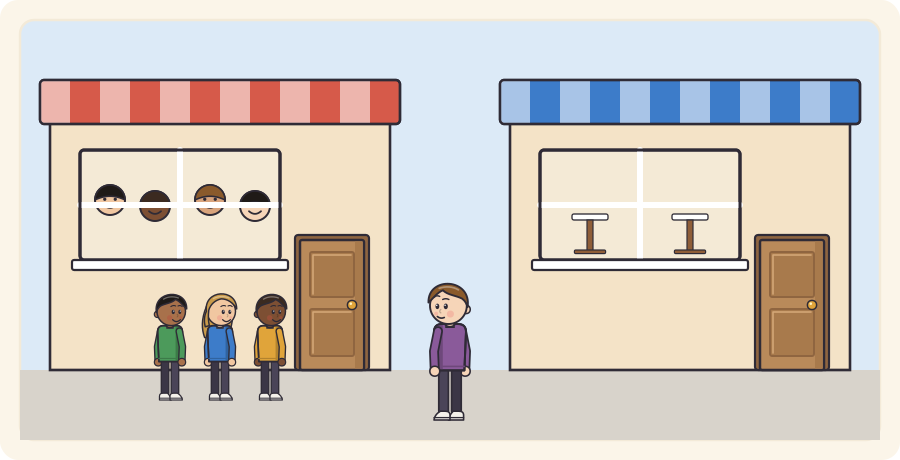
None of these is guaranteed. The empty restaurant may be new and excellent. But you would need a lot of time to check every restaurant in town, and the shortcut gives a decent answer in a second. That is the trade: a little accuracy for a lot of speed.
What helps
Shortcuts work best where they grew up: everyday choices you make often, where a small mistake costs little. When a choice is big, rare or new, slow down and ask: what is my shortcut using here, and does it fit this case? "Pick the one I've heard of" is fine for cities. It is a poor way to pick a doctor or a bank.
Try it on a friend
- Ask a friend which of two cities they don't know well is bigger, for example two cities in a faraway country.
- Ask how they chose. Most people will say "I'd heard of that one", or "it sounded bigger".
- Look it up together and see whether the shortcut worked.
Words to know
- mental shortcut (heuristic) - a quick rule of thumb that gives a good-enough answer without slow thinking
Big idea
Much of fast thinking runs on mental shortcuts. They are quick and usually good enough, which is why we have them. Slow down when the choice is big or unusual.