Ask How You Could Be Wrong
Try this first
You read a study that agrees with something you already believe, and you want to judge it fairly. Which would help you more: telling yourself "be fair and unbiased", or asking "what would I think of this study if it had found the opposite?" Pick one before reading on.
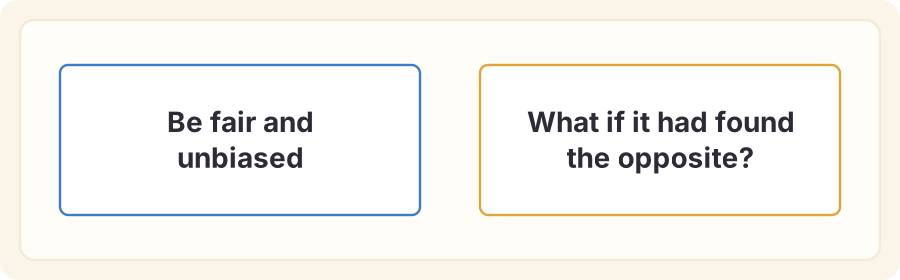
Many people pick "be fair", or think the two are the same. Surely wanting to be fair is the first step. This last lesson shows what really helps, and then collects the habits from the whole course.
Wanting to be fair isn't enough
Charles Lord, Mark Lepper and Elizabeth Preston (1984) asked people with strong views on a debate topic to read two studies, one for their side and one against. Usually, people judge the study on their own side as better done. Some were told to be as fair and unbiased as they could, like a judge. Others were told: at each step, ask yourself whether you would have judged the study the same way if it had found the opposite result.
Show the answer
Asking about the opposite helped much more. The "be fair" group was just as one-sided as people given no advice at all. The "opposite" group judged the two studies far more evenly.
"Be fair" fails because we already feel fair, as the lesson Biased? Who, Me? showed. Asking about the opposite gives the mind a real job: it brings up the reasons you would otherwise skip. This is called considering the opposite.
It works on anchors too
Thomas Mussweiler, Fritz Strack and Tim Pfeiffer (2000) asked car experts in Germany to price a used car after hearing a seller's price. Experts who first listed reasons why that price might be wrong were pulled by it much less. Knowing cars hadn't protected them, as in Even Experts Are Anchored, but asking how the number could be wrong did.
The pre-mortem
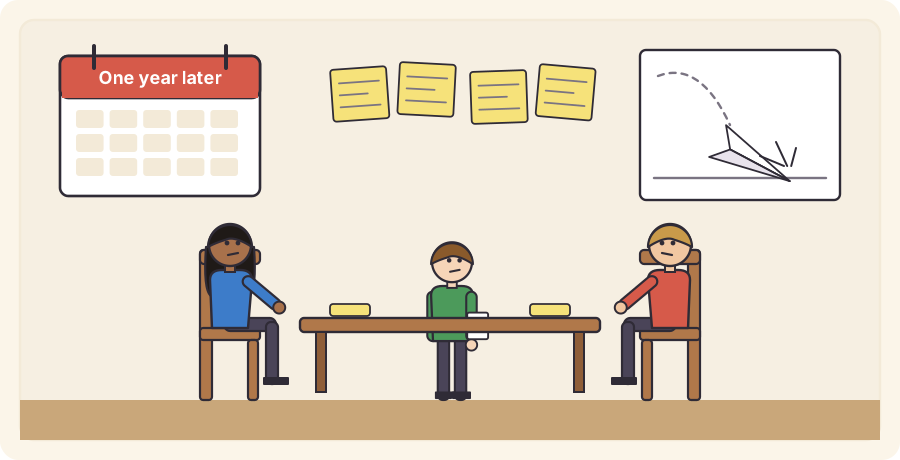
Gary Klein (2007) turned the same idea into a habit for plans. Before a team starts, everyone imagines: "It is a year from now, and the plan failed. Why?" Each person writes down reasons. This is a pre-mortem. Imagining the failure as already real makes it easier to find reasons, and saying them out loud becomes a task, not a lack of team spirit.
What helps
- Flip the evidence: what would I think if it had pointed the other way?
- List reasons a number or a belief could be wrong before you settle.
- Before a big plan, run a pre-mortem.
The habits from this course
- Check a quick answer slowly (Fast and Slow).
- Only the future counts, not what you have already spent (The Ticket You Already Bought).
- Check what is already ticked (The Box Already Ticked).
- Say it the other way round (Same Facts, Different Words).
- Ask what situation would make you do that (The Driver Who Cut In).
- Ask how long similar jobs took (It Will Only Take an Hour).
- Ask what part you actually control (Throwing the Dice Harder).
- Write your reasons down before you choose (The Photo You Didn't Choose).
- Try the case that could prove you wrong (Testing Your Own Idea).
Try it on a friend
When a friend is excited about a plan, offer a kind pre-mortem together: "Let's imagine it went wrong. What would the reason be?" Then help them fix the top reason.
Words to know
- considering the opposite - asking what you would think if the evidence had pointed the other way
- pre-mortem - imagining a plan has already failed, and asking why
Big idea
Knowing about biases doesn't switch them off, and trying to be fair isn't enough. Asking how you could be wrong is a habit that really helps.