Us and Them
Try this first
For a school sports day, names are drawn from a hat to make two teams, Blue and Yellow. You are Blue. You must give out points to two students you have never met: one from Blue, one from Yellow. Which do you pick, A or B?
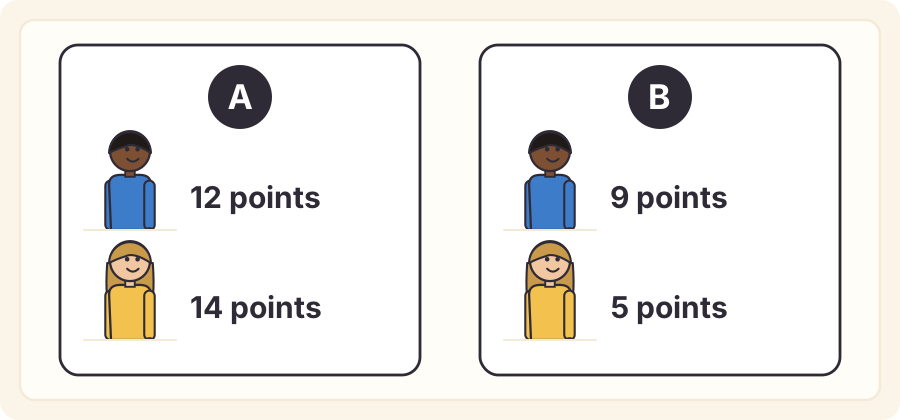
Many people feel a pull towards B. It feels like a win: Blue beats Yellow. But look again at what B gives your own teammate.
Show the answer
With A, your Blue teammate gets 12 points. With B, only 9. Choosing B means your own team gets less, just so it ends up ahead of the other team. Both teams were made by drawing names from a hat a few minutes ago.
Teams made of almost nothing
In 1970 and 1971 the psychologist Henri Tajfel and his colleagues ran a set of studies with schoolboys in the United Kingdom. The boys looked at pictures by two painters, Paul Klee and Wassily Kandinsky, and said which they liked better. Then each boy was told he was in the "Klee group" or the "Kandinsky group". In fact the groups were made at random.
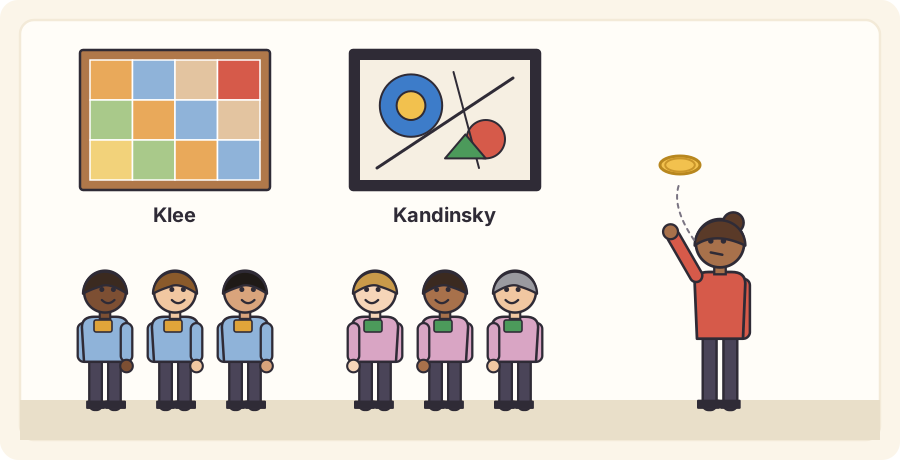
Each boy then gave out small amounts of money to other boys, known only by a code number and a group. He never met them, and he got nothing himself. Still, the boys gave more to their own group. And they often picked choices that made the gap between the groups bigger, even when another choice gave more to everyone, their own group included.
Your own group is your in-group, and the other group is the out-group. Favouring your own group, even for no real reason, is called in-group bias.
"They are all the same"
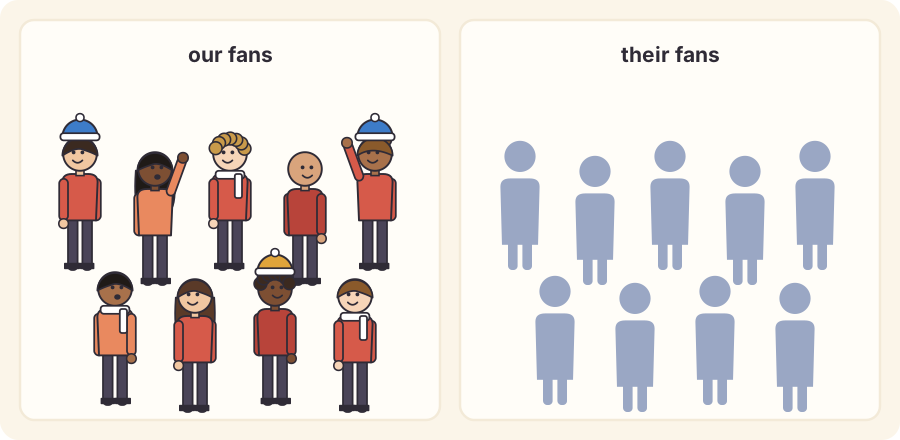
There is a second part. We see our own group as a crowd of different people, each with their own story. We tend to see "them" as all alike. A football fan can tell you how every friend in the stands is different, then describe the other team's fans in one sentence.
Why the mind does it
For most of human history, your group was your safety: the people who shared food and helped you. Feeling close to them is useful, and it is also what makes teams, clubs and friendships feel warm. The shortcut misfires when "which group are they in?" starts deciding things it has no right to decide: who gets the job, who gets the benefit of the doubt, who gets the bigger share.
You can see it between two classes in one school, two teams at one office, or two sets of fans on a Saturday.
What helps
When you judge someone, notice if "which group are they in?" is doing the judging. Ask: would I think the same if they were in my group?
Try it on a friend
- Ask a friend about two teams, clubs or schools: their own and a rival.
- Ask them to describe the people in each one in three words.
- Notice which description is more varied. Then try it on yourself.
Words to know
- in-group - a group you belong to
- out-group - a group you don't belong to
- in-group bias - favouring your own group over others, even when the groups mean very little
Big idea
Split people into teams for almost any reason and they start to favour "us". Notice when the group, not the person, is doing the judging.