Biased? Who, Me?
Try this first
You have now read about more than twenty mistakes the mind keeps making. Compared with the average person, how much do they affect you? Pick one: less than most people, about the same, or more than most people.
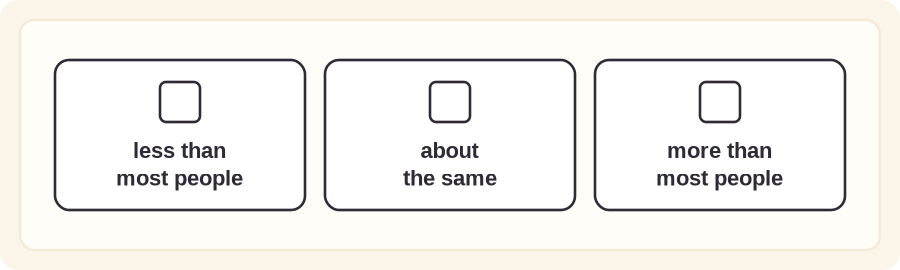
If you picked "less than most", you are in good company: that is what most people pick. But we can't all be less biased than the average person. So why do we see biases in others so easily, and so rarely in ourselves?
The study
Emily Pronin, Daniel Lin and Lee Ross (2002) asked students at a university in the United States to read short descriptions of several biases. One was taking the credit when things go well and blaming bad luck when they go badly. Another was judging people more kindly when they agree with you. Then the students rated how much each bias affected them, and how much it affected the average student.
For almost every bias, the students rated themselves less biased than the average student. They did this right after reading what the biases were. Travellers at an airport in the United States answered the same way.
In another part of the study, people first rated themselves as better than most of their classmates at many things, as in the lesson Better Than Most. Then the researchers explained that effect to them. Most still said their own ratings were accurate.
Seeing biases in other people more than in yourself is called the bias blind spot.
Why we miss our own
When we judge ourselves, we look inside. We search our thoughts and feelings for bias, find none, and decide we are fair. But a bias doesn't come with a feeling. Looking inward tells you poorly why you choose what you do (see introspection), so the search finds nothing even when the bias is there.
When we judge other people, we can't look inside them. We look at what they do: what they chose, what they said, who they sided with. And from the outside, a bias is much easier to see.
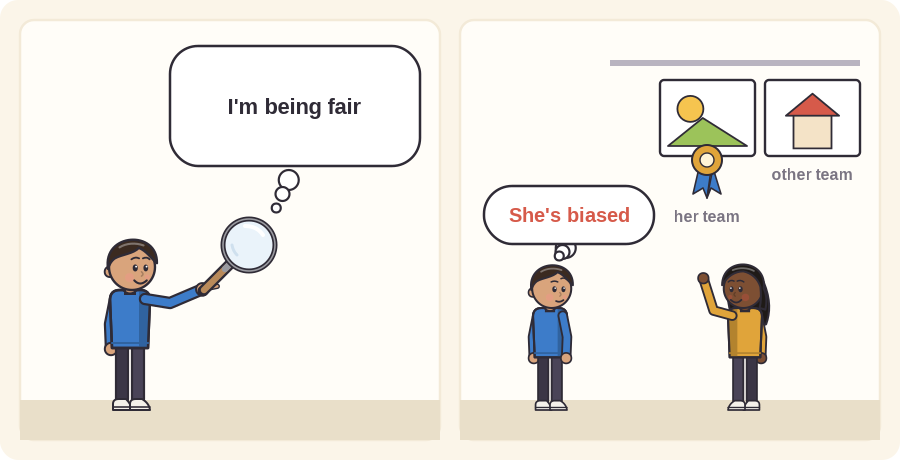
This doesn't make anyone a bad person. The blind spot is in everyone, like the real blind spot in each of your eyes, the small place where the eye can't see and the brain quietly fills the gap.
What helps
- Judge yourself the way you judge others: by what you did, not by how fair you felt while doing it.
- Borrow other people's eyes. Since you can't see your own blind spot, ask a friend you trust: "Where might I be biased here?" Then listen without arguing back straight away.
Catch it this week
Watch for the moment you think "they only think that because ..." about someone. When it comes, stop and ask: could someone say the same about me? Keep a count of how often it happens this week.
Words to know
- bias blind spot - seeing biases in other people more easily than in yourself
Big idea
Almost everyone thinks they are less biased than most people, because we look for bias inside ourselves and find nothing. Judge yourself by what you do, and let others' eyes help.