Testing Your Own Idea
Try this first
I have a secret rule for sets of three numbers, and 2, 4, 6 follows it. Guess the rule. Then write down three sets of numbers you would ask me about to check your guess. I answer each set with "yes" or "no".
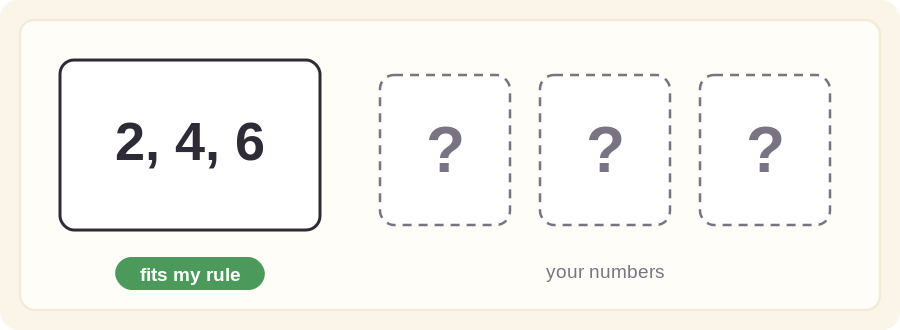
Most people guess "numbers going up by 2", test 8, 10, 12 or 20, 22, 24, hear "yes" each time, and feel sure. Did you write any set that your guess says should get a "no"? This lesson is about how we test our own ideas, and why the usual way can hide the truth.
The 2, 4, 6 game
The psychologist Peter Wason (1960) played this game with university students in England. Each could try as many sets as they liked, then announce the rule. Most tried set after set that fitted their guess. Very few tried 1, 2, 3 or 6, 4, 2, which their guess said would be a "no".
Show the answer
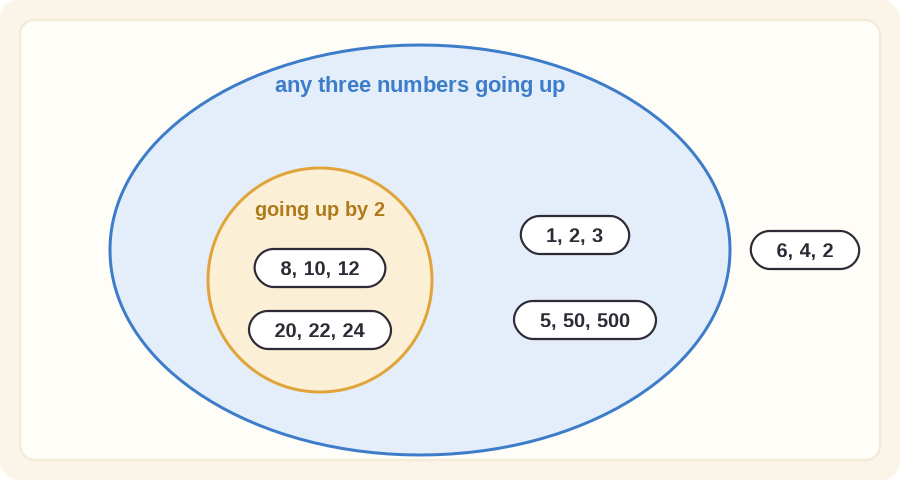
The rule was any three numbers going up. So 8, 10, 12 fits, but so do 1, 2, 3 and 5, 50, 500. Only about 1 in 5 students named it the first time they announced a rule. The others were sure of a rule that was too narrow.
Why a yes can't tell you much
You may know confirmation bias: we notice and remember what fits what we believe. The 2, 4, 6 game shows its second side: we also test our ideas by looking for what fits.
The trouble is that 8, 10, 12 fits "going up by 2", and it also fits "any numbers going up". A yes can't tell the two rules apart, so a hundred yeses teach you nothing new. The test that teaches you something is one where your guess says "no": try 1, 2, 3. If the answer is "yes", your guess was wrong, and you have learned the most useful thing in the game.
Looking for a yes isn't silly: when your guess is right, yeses are what you will get. The mistake is stopping there. A yes feels like proof, so the mind never tries the case that could surprise it.
Where it shows up
Mina is sure her plant grows better with music. She plays it music every day, and every week it is taller. Yes, yes, yes. But plants grow anyway. The test that could prove her wrong is a second plant in the same window, with no music. It is the same when you think a lucky pen helps you in tests but never sit a test without it.
What helps
- Ask: what result would show I'm wrong? Then look for exactly that.
- Try a case your idea says should fail. If it fails, your idea passed a real test. If not, you learned something.
Testing an idea by trying to break it is how scientists work. An idea that survives your best attempts to break it is worth far more than one that has only heard "yes".
Try it on a friend
- Tell a friend that 2, 4, 6 follows your secret rule: "any three numbers going up".
- Answer each set they try with only "yes" or "no", until they name the rule.
- Count how many of their sets could have got a "no". Then swap, with a rule of their own.
Words to know
- testing an idea by trying to break it - checking an idea with the case that could prove it wrong, not only with cases that fit it
- confirmation bias - noticing, remembering and testing what fits what we already believe
Big idea
A "yes" from a test your idea was sure to pass tells you little. To find out if you are right, try the case that could prove you wrong.