Draw a Bicycle
Try this first
How well do you understand how a zip works, the kind on a jacket? Give yourself a score from 1 (not at all) to 7 (completely). Now explain, step by step and out loud, what happens inside it when you pull it up. Then score yourself again.
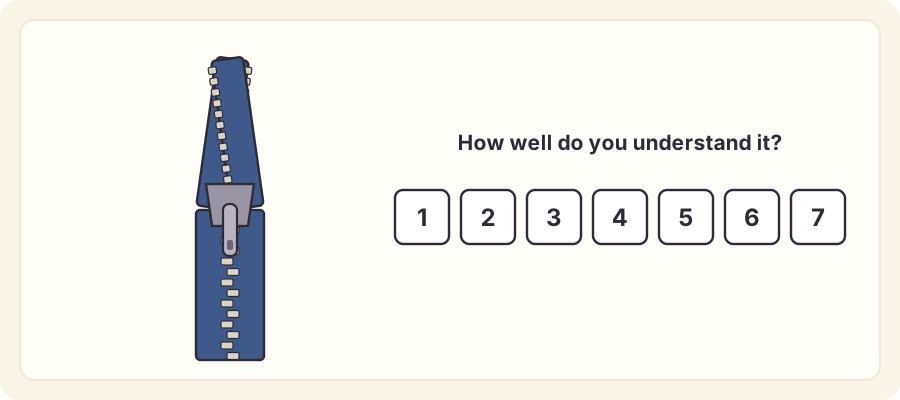
Most people start with a 5 or a 6. Then they try to explain how the little teeth lock together, and the words run out. The second score is lower. Did you know less than you thought, or did you only find out now?
Scores that dropped
In 2002 the psychologists Leonid Rozenblit and Frank Keil asked people in the United States the same thing about everyday objects: a zip, a flush toilet, a lock with a key. First people gave a score from 1 to 7 for how well they understood each one. Then they wrote a full explanation, step by step. Then they scored themselves again.
The second scores were clearly lower. Many people said, in effect, "I thought I knew this." They had been sure because the object was familiar: they had used it a thousand times. Using a thing, though, is not the same as knowing how it works.
The bicycle test
In 2006 Rebecca Lawson, a psychologist in England, asked people to draw a bicycle from memory. She gave them a simple outline to finish: they only had to add the frame, the pedals and the chain. Nearly everyone has seen thousands of bicycles, and most people say they know roughly how one works.
Many of the drawings could never have been ridden. Some had the chain going to the front wheel, so the bike couldn't be steered. Some had the chain going around both wheels. Some had the frame fixed to the middle of the front wheel, so the handlebars couldn't turn it. People who rode bicycles often did better, but many of them also got it wrong.
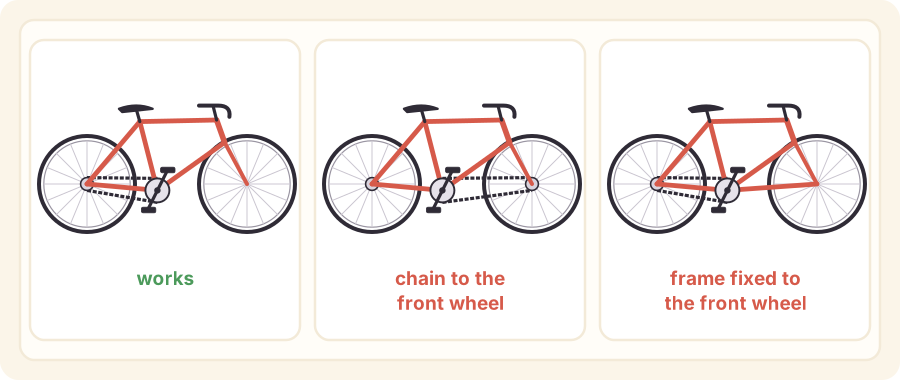
This feeling of knowing how something works, when we don't, is called the illusion of understanding. Psychologists also call it the illusion of explanatory depth: the explanation we think we have is shallower than it feels.
Why the mind does it
We don't need to know how a zip works to use one. Most of the time we can lean on the people who do know: the maker, the repair shop. So the mind keeps a sense of "I've got this" instead of the details, and the sense is usually good enough. The trouble starts when we have to fix the thing, teach it, or argue about it. Then the missing details matter.
What helps
- Explain it out loud, step by step, before you say you understand. Where you get stuck is where your knowledge ends.
- Score yourself after explaining, not before. The second score is the one to trust.
Try it on a friend
- Ask a friend to score from 1 to 7 how well they understand how a toilet flushes, or how a lock opens with a key.
- Ask them, kindly, to explain it to you step by step. Then ask for a score again.
- Do it yourself too, with a different object. Compare the drops.
Words to know
- illusion of understanding - feeling that we know how something works, until we try to explain it
- illusion of explanatory depth - another name for the same thing: our explanation is shallower than it feels
Big idea
A thing we use every day feels understood. Explaining it step by step shows how much we really know, so explain first and judge after.