The Box Already Ticked
Try this first
You are signing up for a new game on your phone. This is the last screen. Look at it for three seconds, as you would on a real phone. Would you change anything before you press "Done"?
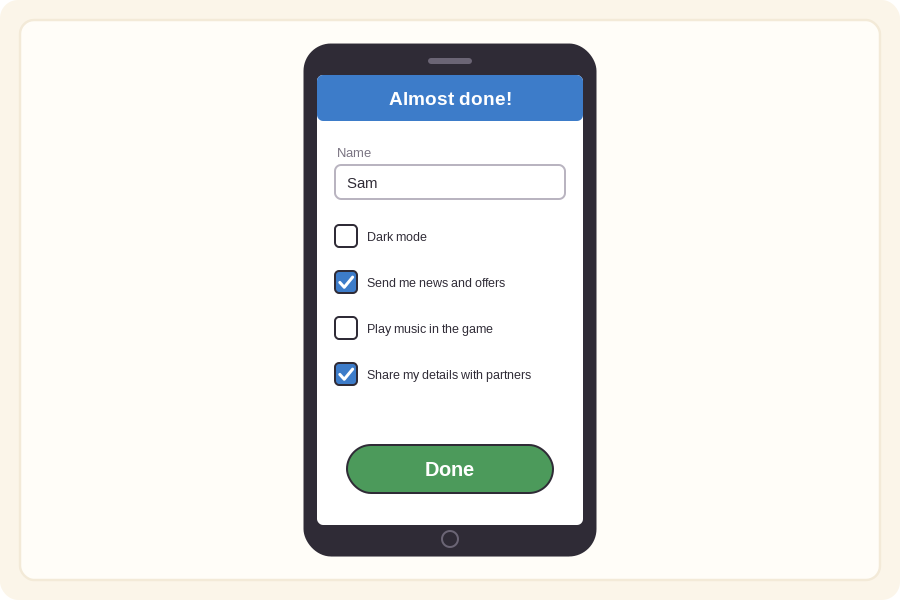
Most people press "Done" straight away. Did you read every box? Two of them were already ticked: one sends you news and offers, the other shares your details with other companies. Pressing "Done" kept both. So who made that choice: you, or whoever ticked the boxes?
What happens if you do nothing
Almost every choice has an option that happens if you don't act: the box already ticked, the setting already switched on, the plan you are already in. This option is called the default. Most people keep it, much more often than they would pick it on their own. This is the default effect.
Brigitte Madrian and Dennis Shea (2001) saw it in a large company in the United States. The company had a savings plan for when workers grow old. At first, new workers had to sign up to join it, and fewer than half did. Then the company changed one thing: new workers were put into the plan automatically, and could leave any time with one form. Now almost 9 in 10 stayed in.
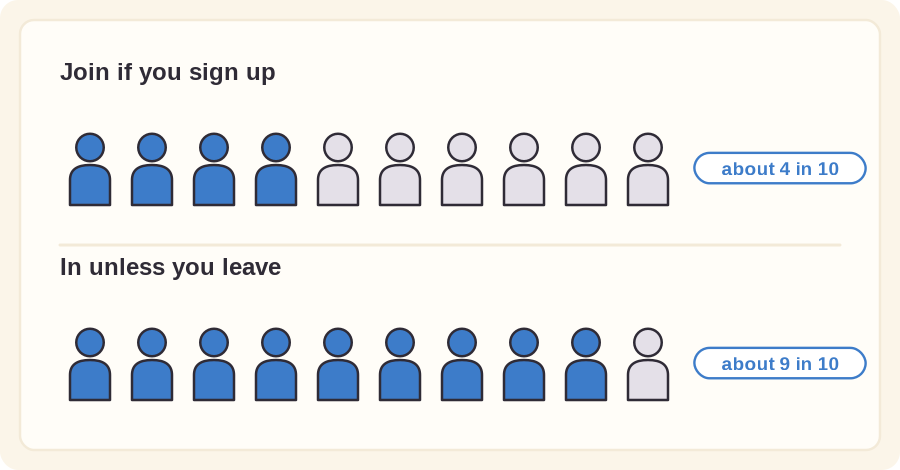
The workers were the same kind of people with the same choices. Only the starting point had changed. Most of them even kept the small amount the company had picked for them to save, though many would have chosen more on their own.
Why the mind does it
There are three good reasons we keep defaults:
- It is easy. Doing nothing takes no effort, and slow thinking is happy to skip the work (see Fast and Slow).
- It looks like advice. We guess that the default is the one the experts recommend.
- Switching feels like giving something up. Leaving the default can feel like a loss, and losses hurt more.
Often these are fine reasons. Someone who knows more may really have picked a good default. The trouble comes when the person who set it wants something different from what you want.
Where it shows up
Phone apps that share your location unless you switch it off. Subscriptions that renew by themselves. A café's app with "large" already selected. Defaults can also help: a printer set to print on both sides saves paper for everyone who never touches the setting.
What helps
Whoever sets the default has power. Before you press "Done", look at what is already ticked, and ask: "Would I tick this if it were empty?" And when you set things up for others, like a family group chat, choose the default you think is best for them, because most will keep it.
Try it on a friend
- Write two little forms for a family meal. On one, "Yes, I'd like dessert" is already ticked. On the other, the box is empty.
- Give one form to each of two people, and see who ends up with dessert.
- Afterwards, show them both forms and talk about it together.
Words to know
- default - the option that happens if you do nothing
- default effect - people keep the default much more often than they would choose it on their own
Big idea
Doing nothing is a choice too, and someone else may have made it for you. Check what is already ticked, and when you set defaults for others, set kind ones.