Red Is Due
Try this first
A fair coin has landed on heads five times in a row. It is about to be tossed again. Which is more likely now: heads, tails, or are they just as likely?
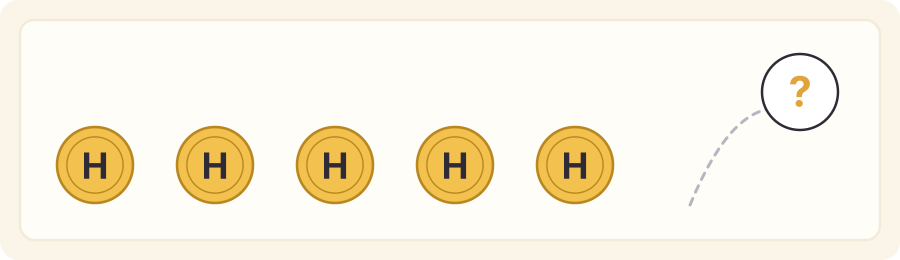
Many people feel that tails must be more likely now. Five heads is a lot, and surely the coin has to "even things out". Others feel heads is on a streak. Both feelings are strong. Are either of them right?
Show the answer
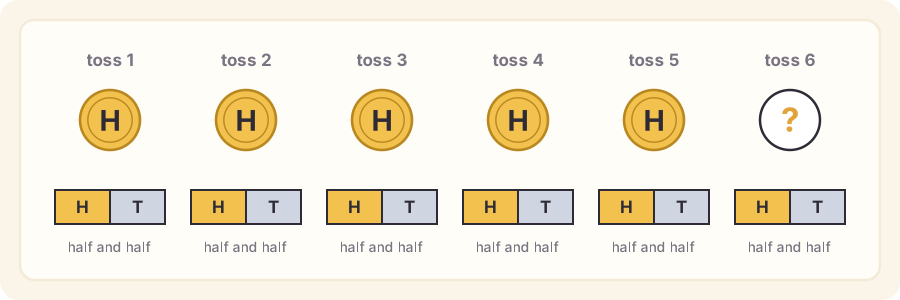
They are just as likely. On the sixth toss, heads and tails are still half and half, exactly as on the first. The five heads before it don't change anything.
Twenty-six times black
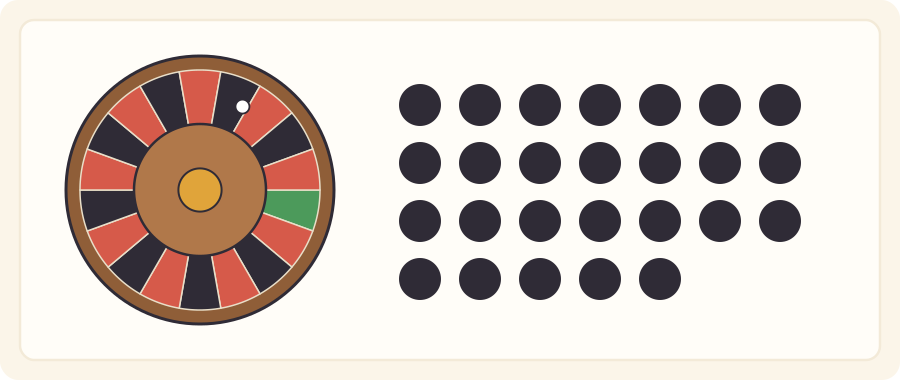
On 18 August 1913, in the casino at Monte Carlo, a roulette wheel landed on black again and again. As the run grew, the people watching became sure that red was "due", and they kept putting more and more money on red. The wheel landed on black 26 times in a row. Those who had bet on red lost a great deal.
The wheel had no idea what it had done before. On each spin, red and black had the same chance as on every other spin. The run of black was rare, but it said nothing at all about the next spin.
The coin has no memory
A coin doesn't remember its last toss. It has no plan to come out even. Each toss is a new start, with the same two equal halves. Believing that a run of one result makes the other one "due" is called the gambler's fallacy (a fallacy is a mistake in reasoning).
Why the mind does it
We know that over many tosses, a coin comes out roughly half heads and half tails. So we expect even a short stretch of tosses to look half and half too. Five heads looks "unfair", and the mind wants the next toss to fix it.
But a coin evens out over thousands of tosses only because the run of five gets lost among all the others, not because tails catches up. This is the same mistake as in Faces in the Clouds: we expect chance to look smoother than it does.
Where it shows up
- "We've had three girls, so the next baby is surely a boy." For each baby, the chance is still about half and half.
- "This lottery number hasn't come up for months, so it must be soon." The machine doesn't know.
- "No six all evening in this board game, so a six is coming." The dice has no idea what it rolled before.
What helps
When you feel something is "due", ask: does this thing remember? A coin, a dice, a wheel or a lottery machine doesn't. If it doesn't, the past run tells you nothing about the next try. (The surest way to stay out of this trap is not to bet at all: these games are built so that, over time, the players lose.)
Try it on a friend
- Toss a coin with a friend until you get three heads in a row.
- Before the next toss, ask: "Which is more likely now?"
- Then explain the coin with no memory, and toss a few more times together to see.
Words to know
- gambler's fallacy - the mistaken belief that after a run of one result, the other result is "due"
Big idea
A coin, a dice or a wheel has no memory. After any run, the next try has the same chances as the first one.