Nobody Is Looking That Hard
Try this first
You walk into a room of 20 students wearing a T-shirt you find really embarrassing. You stay a minute and leave. How many of the 20 do you think noticed what was on your T-shirt? Write a number.
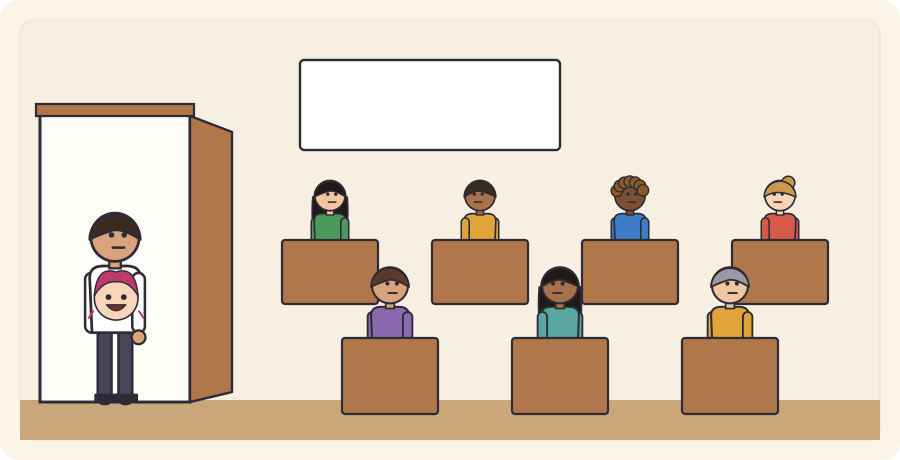
Most people guess about half, around 10. It feels obvious that a room would notice. But the people in the room have their own things to think about. How many of them really looked?
The T-shirt study
In 2000 the psychologists Thomas Gilovich, Victoria Medvec and Kenneth Savitsky ran this exact test with university students in the United States. Each student put on a T-shirt with the face of a famous singer on it, one that most students their age found embarrassing to wear. Then they walked into a room where other students sat filling in forms, stayed for a moment, and left.
Afterwards the researchers asked the student in the T-shirt: how many people in the room could say whose face was on your shirt? They also asked the people in the room.
Show the answer
The students in the T-shirt guessed that about half of the room had noticed. In fact only about a quarter could say whose face it was. Most people had looked up, seen a student, and gone back to their forms.

The feeling that a light is on us, so that everyone sees what we wear, say and get wrong, is called the spotlight effect. We feel more noticed than we are.
Why the mind does it
You are at the centre of your own attention all day. You know about the stain on your sleeve, the word you got wrong, the hair that won't lie flat. Because it is so big in your own mind, it seems it must be big in other minds too. But each person in the room is at the centre of their own attention, not yours. They are thinking about their own sleeve.
Caring how others see us is useful: it keeps us polite and part of the group. It only misfires when the worry is much bigger than the attention really paid.
Where it shows up
A bad hair day. A mistake in a class talk. A wrong note in a school concert. Tripping on the stairs. Each feels huge at the moment, and most people who saw it have forgotten it by the evening. The same studies found the effect for good things too: people think others notice their clever comments more than they do.
What helps
- Ask what you noticed about others. Think back to the last talk you watched. Can you remember anyone's small mistakes? Others remember yours just as little.
- Let the light go. When you feel watched, tell yourself: "most of them are thinking about themselves." It is usually true, and it is a kind thing to know.
Try it on a friend
- Wear something a little unusual for a day: odd socks, a bright hat, a badge.
- In the evening, ask a few friends or family members if they noticed anything different about you. Before asking, guess how many will say yes.
Words to know
- spotlight effect - feeling that other people notice our looks and mistakes much more than they do
Big idea
Each of us is at the centre of our own attention, not everyone else's. Others notice far less about you than you think, and that can set you free.