The Halo
Try this first
Two new students join your class. Look at them for a moment, then answer quickly. Which one is probably better at maths? Which one is probably kinder?

Many people pick the smiling, neat student for both questions. Some pick the other one for maths, as a kind of opposite guess. Either way, they answer. But what in the picture could tell you anything about maths?
Show the answer
Nothing. A smile and a clean shirt say nothing about maths, and very little about kindness. If you had an answer ready, one thing you could see quietly decided things you couldn't.
One good thing spreads
In 1920 the American psychologist Edward Thorndike looked at how army officers rated their soldiers on many qualities: looks, intelligence, loyalty, leadership. Something odd showed up. A soldier rated high on one quality was rated high on almost all of them. A soldier rated low on one was rated low on the rest. The qualities can't really be that tied together. The officers were forming one overall feeling, and it coloured every score.
Thorndike called it the halo effect, after the ring of light painted around a saint's head in old pictures. One shining quality seems to light up all the others.
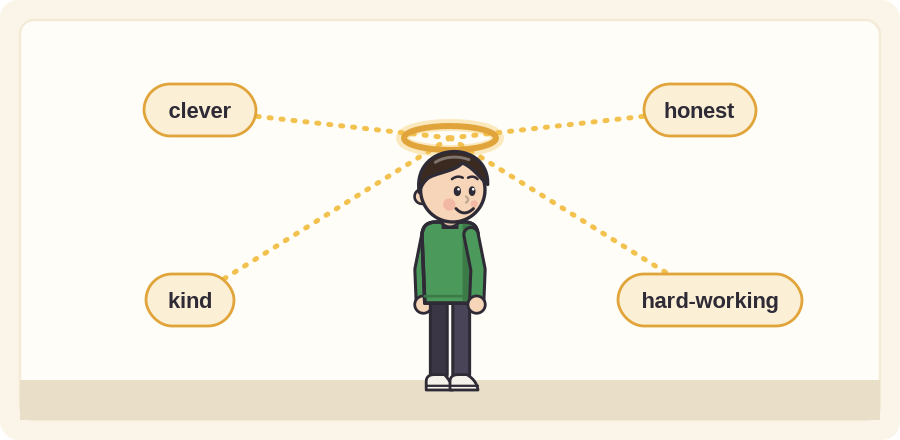
We don't notice it happening
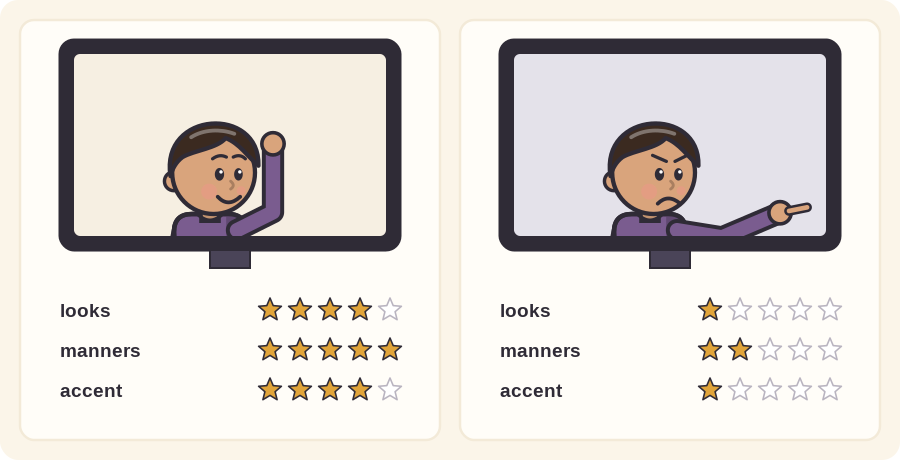
Richard Nisbett and Timothy Wilson (1977) showed students a short video of a college teacher who spoke English with an accent from another country. Half the students saw a version where he was warm and friendly. The other half saw the same man, cold and strict.
Afterwards the students rated his looks, his manners and his accent. The warm version's viewers found all three likeable. The cold version's viewers found the very same looks, manners and accent irritating. When asked, the students said his warmth had not affected those ratings at all.
Why the mind does it
Judging a person quality by quality is slow work. A single overall feeling, "I like them" or "I don't", is quick, and it often points the right way. But it leaks into judgements it has no right to. It works the other way too: one bad trait can darken the rest (sometimes called the "horn effect").
You see it every day: good-looking or confident people seem cleverer, a shop with a beautiful front seems to sell better things, and a famous name on a product makes it seem better made.
What helps
When you have to judge someone, judge one quality at a time, and ask for each one: "What have I actually seen of this?" Teachers who mark one question across all the papers, instead of one paper at a time, are using this habit.
Try it on a friend
- Show two friends, separately, the same short drawing or poem.
- Tell one: "This is by a student who wins every prize." Tell the other nothing.
- Ask each to score it from 1 to 10. Then show them both this lesson.
Words to know
- halo effect - when one good quality makes us see other good qualities in a person or a thing
Big idea
One quality we like can light up everything else about a person. Judge one quality at a time, and ask what you have really seen.