Faces in the Clouds
Try this first
Below are two rows of 20 coin tosses. One row is real chance: a fair coin, tossed 20 times. The other was made up by a person trying to make it look like chance. Which row is the real coin?
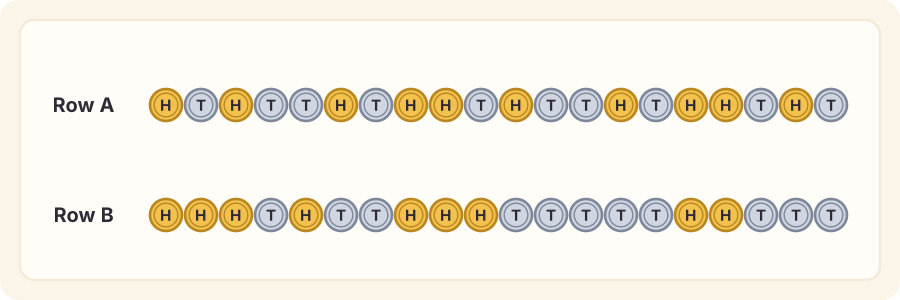
Most people pick row A. It looks nicely mixed, as chance should. Row B has long runs, and runs look planned.
Show the answer
Row B is the real coin (a computer tossed a fair coin 20 times for us). Row A was made up. People making up tosses switch sides far too often, because a run of four or five feels wrong. A real coin doesn't care how it feels.
Chance is clumpy
Something is random when it happens by chance, with no plan and nothing steering it. We tend to think random things come out evenly spread. They don't. In 20 tosses of a fair coin, about 3 times in 4 there is a run of at least four of the same side somewhere. Chance makes clumps and gaps all the time.
The bombs on London
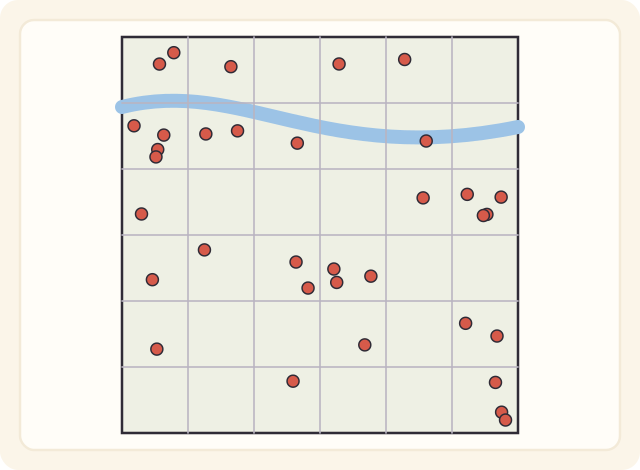
In 1944, during the Second World War, flying bombs fell on London. People noticed that some streets were hit again and again, while others were spared. Many were sure the bombs were being aimed, and some wondered whether the spared areas were where spies lived.
After the war, R. D. Clarke (1946) checked. He divided part of south London into 576 small squares of the same size and counted the hits in each. The counts were just what pure chance gives: many squares with no hit, some with one, a few with three or four. The clumps were chance.
Why the mind does it
Finding patterns is one of the mind's best tools: an animal's footprints, ripe fruit, a friend's face in a crowd. For our ancestors, missing a real pattern (a lion in the grass) could cost a life. Seeing one that isn't there cost only a moment of worry. So the mind would rather see too many.
That is why we see faces in clouds, in the front of a car, even in a wall socket (this has a name: pareidolia). And it is why we take the clumps that chance makes for a sign of something real. This mistake is called seeing patterns in chance (psychologists also call it the clustering illusion). Like every bias in When Shortcuts Go Wrong, it is a shortcut that usually helps.

Where it shows up
People once complained that their music player's shuffle played the same singer twice in a row, so it couldn't be random. It was random. In 2005 Steve Jobs said Apple was making its shuffle less random, so that it would feel more random. A "lucky" week or "things come in threes" are often clumps of chance too.
What helps
- Before you decide a clump means something, ask: would chance alone make a clump like this? Usually it would, more often than you think.
- Wait for more. A real pattern keeps showing up. A chance one fades.
Try it on a friend
- Ask a friend to write 20 made-up coin tosses, H or T, that look like chance.
- Then toss a real coin 20 times together and write those down too.
- Find the longest run in each row. The real coin almost always has the longer one.
Words to know
- random - happening by chance, with no plan and nothing steering it
- seeing patterns in chance - taking the clumps and gaps that chance makes for a sign of something real (also called the clustering illusion)
Big idea
Real chance is clumpy, and the mind is built to find patterns. Before you read meaning into a clump, ask whether chance alone would have made it.