Your Body Clock
Have you noticed that you get sleepy at about the same time every evening, even with no clock in sight? Or that after a long flight east, you lie awake at night and can't get up in the morning? Something inside you is keeping time.
Myth or fact? Teenagers who go to sleep late are just lazy.
A clock in your brain
Your body has a body clock: an inner timer that runs on a cycle of about 24 hours. It tells your body when to be sleepy and when to be alert, and it also times hunger, body temperature and the release of hormones (chemical messengers in the blood). Scientists call these daily cycles circadian rhythms, from Latin words meaning "about a day".1
The master clock is a small group of nerve cells deep in the brain. It gets signals about light straight from the eyes.1 Light and dark have the biggest effect on it; food, activity, stress and temperature matter too, but less.
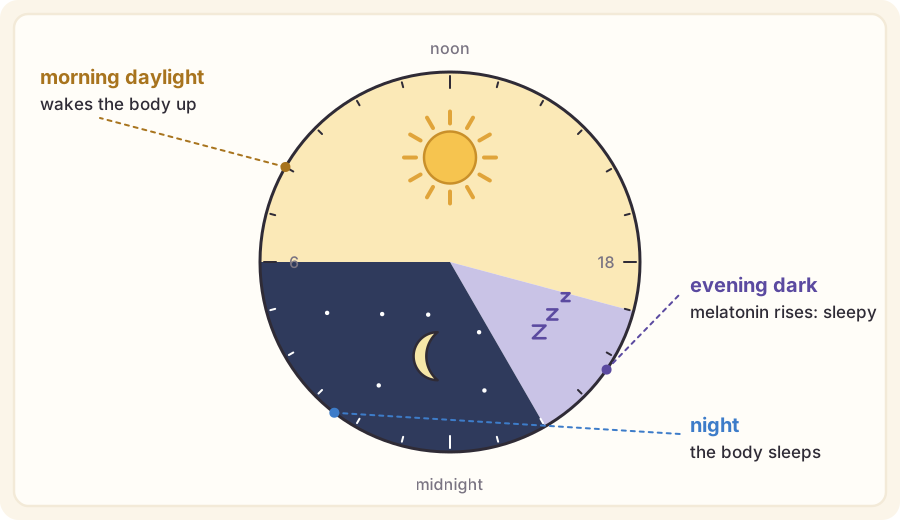
In the evening, as it gets dark, the master clock tells the brain to make more melatonin, a hormone that makes you sleepy. In bright light the brain makes little of it.12
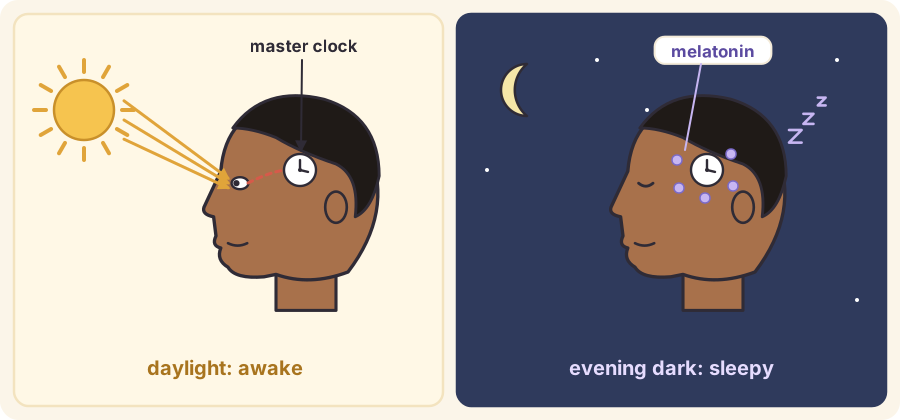
Daylight sets the clock every day
Left alone, in a room with no daylight, most people's inner clock runs a little longer than a day: about 24 hours and 10 minutes.3 That is why it needs setting. Every morning, daylight nudges it back in step with the real day, and evening light pushes it the other way, later.4
Teenagers: a later clock
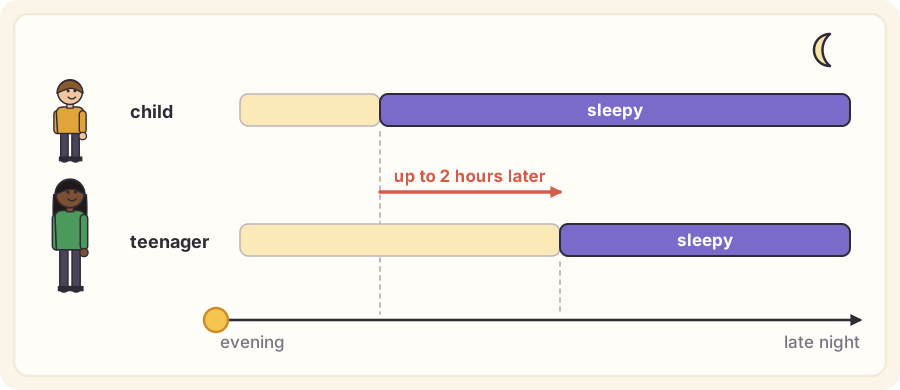
Around puberty, the age when the body starts changing from a child's to an adult's, the body clock shifts later, by up to about 2 hours.5 A teenager who isn't sleepy until late is not lazy: their body clock is running later than it did a few years before. With school starting early in the morning, many teenagers get less sleep than they need.
Show the answer
Myth. At puberty the body clock really does shift later, by up to about 2 hours.5 Bright screens late at night can confuse the clock too.1 But the shift itself is part of growing up.
Jet lag
When you fly across several time zones, the clock on the wall jumps, but your body clock doesn't. For days, your body thinks it is night when it is day. This mismatch between your inner clock and the real clock is jet lag.2 The body clock catches up by about an hour a day after flying east, and about an hour and a half a day after flying west, so flying east is usually harder.4 People who work night shifts face the same mismatch.
What you can do
- Get outside in daylight in the morning, even for a short walk.
- Keep evenings dim and calm, and wake up at about the same time every day.
- After a long flight, spend time in daylight at your new place.
Words to know
- body clock - an inner timer in the brain that makes you sleepy at night and alert in the day
- circadian rhythm - any daily cycle in the body that follows the body clock
- melatonin - a hormone the brain makes in the evening dark, which makes you sleepy
Big idea
A clock in your brain runs your day, and light is what keeps it on time, so morning light helps and late light pushes it later.
Sources
-
National Institute of General Medical Sciences (NIH), Circadian Rhythms (fact sheet). ↩ ↩2 ↩3 ↩4
-
National Institute of Neurological Disorders and Stroke (NIH), Brain Basics: Understanding Sleep. ↩ ↩2
-
Czeisler and others, Stability, precision, and near-24-hour period of the human circadian pacemaker (Science, 1999). ↩
-
CDC, Jet Lag Disorder (CDC Yellow Book, health information for travel). ↩ ↩2
-
American Academy of Pediatrics, School Start Times for Adolescents (policy statement, Pediatrics, 2014). ↩ ↩2