More Than Not Being Sick
A friend asks, "How are you?" You say, "Fine, I'm not sick." But you have slept badly all week, you feel worried about something, and you haven't really talked to anyone for days. Are you healthy? Or is "not sick" only part of the answer?
Myth or fact? If you are not ill, you are healthy.
What the World Health Organization says
In 1946, the countries that started the World Health Organization (WHO) wrote down what they meant by health. Their sentence is still the best-known definition in the world: "Health is a state of complete physical, mental and social well-being and not merely the absence of disease or infirmity."1
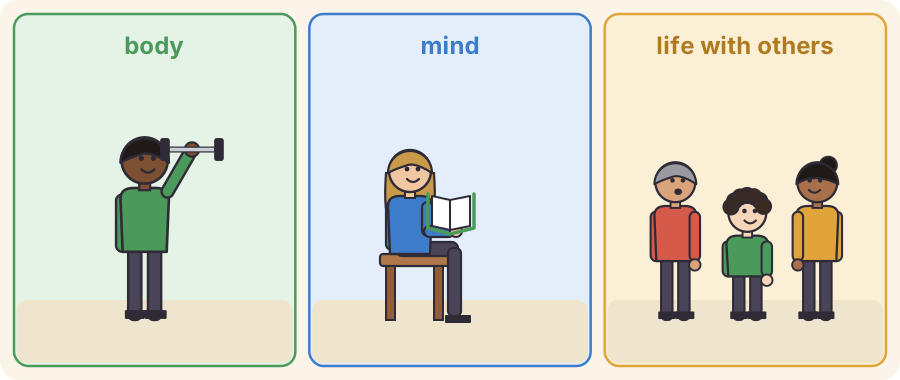
Well-being means feeling well and doing well. So the definition has three parts:
- Body (physical): your body works, has energy and can do what you need.
- Mind (mental): you can think clearly, handle your feelings and cope with everyday worries.
- Life with other people (social): you have people to talk to, help and be helped by.
Show the answer
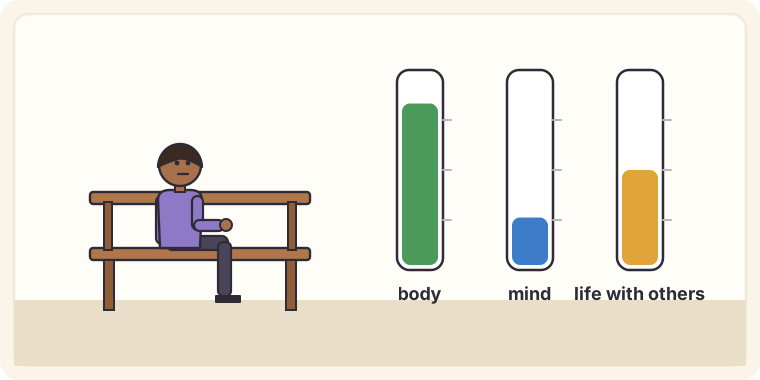
Myth. Not having an illness is a good start, but it is only part of health. By WHO's definition, someone with no disease can still be short of health if they are always exhausted, always worried or always alone.
The three parts work together
The three parts are not separate boxes. Each one changes the others.
Stress, the body's alarm when life feels like too much, can show up in the body as headaches, tense muscles or stomach problems.2 A good night's sleep can make a hard day feel easier. And when you are ill in bed, a friend who checks on you or brings food helps you get through it.
That is why mental health is part of health, not something extra. WHO describes it as a state of mental well-being that lets people cope with the stresses of life, learn and work well, and play a part in their community.3 A whole lesson of this course, Mental Health Is Health, is about it.
What this course is about
Health is not one thing you either have or don't. Some of it you can look after every day. This course covers the parts that the world's big health bodies agree on: sleep, food, moving your body, germs and how the body fights them, teeth, skin, ears and eyes, stress, and friends. It ends with how to judge a health claim yourself.
You can read the lessons in any order. Start with Why We Sleep, Food Is Fuel or People Who Keep Us Well - whatever you want to know first.
Careful
This course is general information, not medical advice. If you are worried about your own health, talk to a doctor, nurse or pharmacist.
Try it this week
Each evening, ask yourself three short questions. How did my body feel today? How did my mind feel? Did I really connect with someone? You don't need to fix anything. Just notice which part could use some care.
Words to know
- health - a state of physical, mental and social well-being, not just the absence of illness (WHO)
- well-being - feeling well and doing well
- World Health Organization (WHO) - the part of the United Nations that works on health around the world
Big idea
Health is more than not being sick: it is your body, your mind and your life with other people all going well.
Sources
-
World Health Organization, Constitution (adopted 1946, in force 1948). ↩
-
World Health Organization, Mental health (fact sheet). ↩