Your Body's Defences
You scrape your knee in the park. By evening the skin around it is pink, warm and a little puffy. A week later it has healed, and you never even noticed the germs that got in. Who dealt with them?
Myth or fact? A fever is the germ itself heating up your body.
The walls: keeping germs out
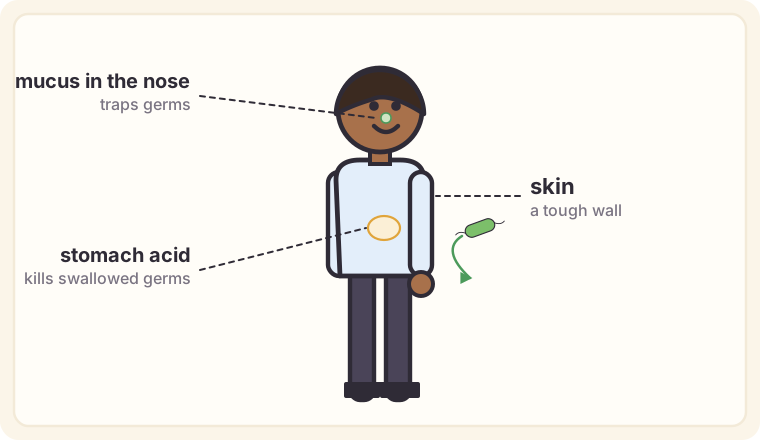
Your immune system is everything in your body that fights germs. Its first job is to keep them out, with barriers:1
- Skin - a tough wall around the whole body. Most germs can't get through unbroken skin.
- Mucus - the sticky liquid in your nose, throat and lungs. It traps germs and dust before they get deeper.
- Stomach acid - kills many germs that you swallow with food and drink.
The fast defence
When germs do get in, through a cut for example, a fast, general defence starts straight away. Nearby blood vessels let more fluid out, so the area becomes red, warm and swollen. This is inflammation, and it brings help to the spot. The help is white blood cells, the body's germ fighters. Some of them swallow germs whole and break them down.1 This defence attacks any germ in the same way.
The targeted defence
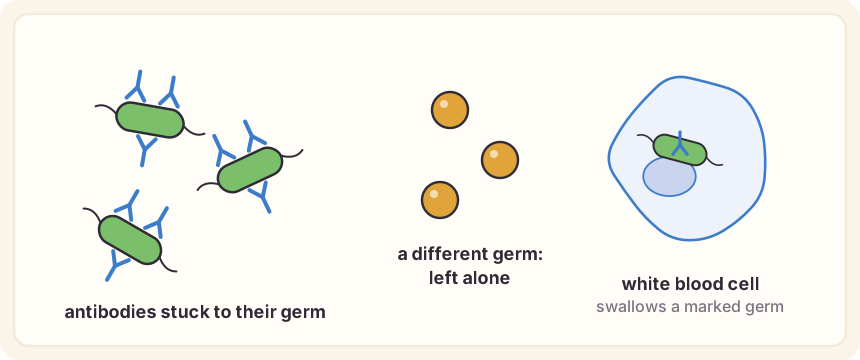
A slower, targeted defence joins in later. Some white blood cells make antibodies: small Y-shaped pieces that stick to one particular germ, and only that one, marking it so it is easier to destroy. Other white blood cells find and kill your own cells that a virus has got into.1
The memory
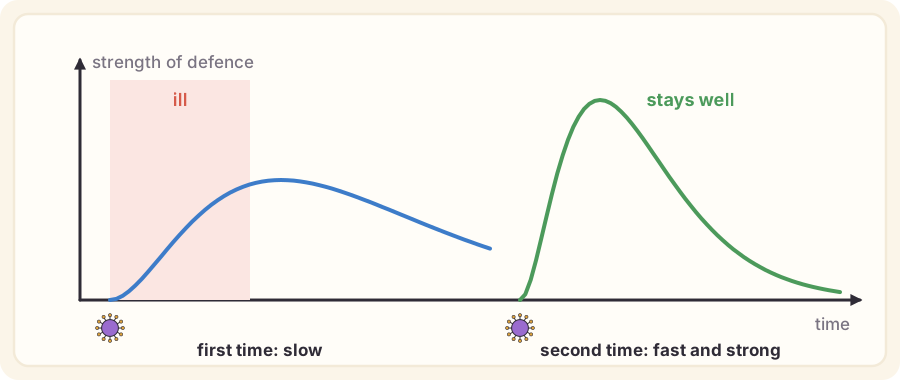
After the fight, some of these targeted cells stay in your body, often for many years. This is immune memory. If the same germ comes back, your body knows it, and the defence is faster and stronger, often so fast that you don't get ill at all.1 That is why most people get some illnesses, like measles or chickenpox, only once.
Fever
A fever is a high body temperature, usually 38 °C or above. It is usually a sign that your body is fighting an infection, such as a cold or flu.2 It is part of the defence, made by your body, not by the germ.
Show the answer
Myth. The germ doesn't heat you up. Your own body raises its temperature as part of its defence. That doesn't mean a fever never needs treating: a doctor or pharmacist can tell you when to bring it down and when to get help.
What you can do
- Clean cuts and scrapes with water and cover them with a plaster: a break in the skin is a gap in the wall.
- Get enough sleep: people who don't sleep enough may get more colds and other infections.3
- If a fever is very high, lasts several days, or you are worried, ask a doctor, nurse or pharmacist.
Words to know
- immune system - everything in your body that fights germs
- white blood cells - the body's germ fighters, carried in the blood
- antibody - a small Y-shaped piece that sticks to one particular germ
- inflammation - redness, warmth and swelling where the body is fighting germs or healing
- fever - a body temperature of about 38 °C or more, usually while fighting an infection
- immune memory - cells that remember a germ, so the next defence is faster
Big idea
Your body defends itself in layers - walls, a fast general defence, a targeted one, and a memory that makes the next fight easier.
Sources
-
MedlinePlus (US National Library of Medicine), Immune response. ↩ ↩2 ↩3 ↩4
-
National Heart, Lung, and Blood Institute (NHLBI), Why Is Sleep Important?. ↩