How Vaccines Work
Your grandparents may remember children who were very ill with measles, or a neighbour who caught polio. Many young people today have never seen either. One of the biggest reasons is a short visit to a nurse and a small plaster on the arm. What does a vaccine actually do?
Practice without the illness
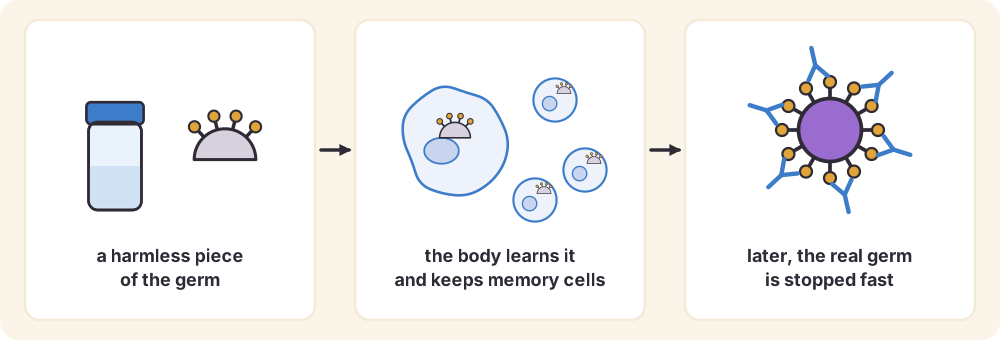
Your immune system, everything in your body that fights germs, has a memory: once it has beaten a germ, it can stop that germ much faster the next time. Usually it learns this by getting ill first. A vaccine lets it learn without the illness.
A vaccine shows the immune system a harmless version of a germ. That can be a killed or weakened germ, a piece of one, or instructions (called RNA or DNA) that tell your own cells to make that piece for a short while. Your immune system learns to recognise it and remembers. Depending on the vaccine, the protection can last for years, decades or a lifetime.1
Protecting the people around you
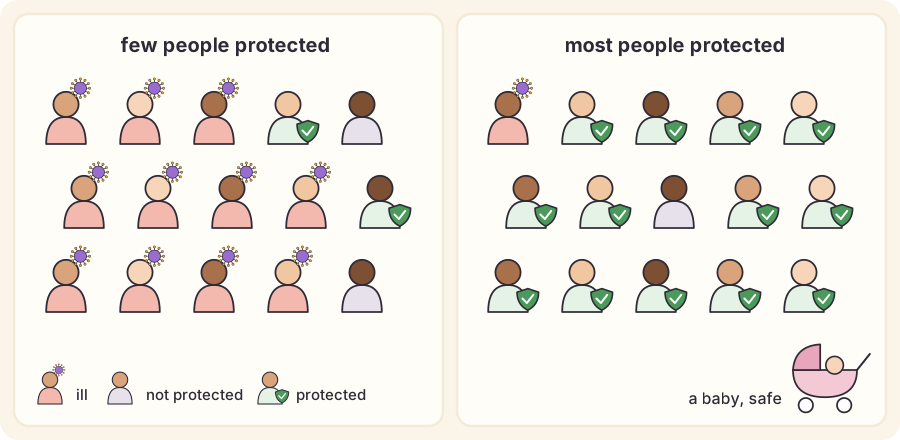
Some people can't be vaccinated, such as very young babies, people who are seriously ill and people with certain allergies. They depend on the people around them.1 When enough people are immune, a germ can't find enough people to spread to, and outbreaks die out. This is called community immunity, or herd immunity.
How many is "enough" depends on how easily a germ spreads. Measles spreads very easily: one person with measles can infect up to 18 others who are not protected.2 So the World Health Organization (WHO) says at least 95% of people need two doses of measles vaccine to stop it spreading.3
What vaccines have done
Smallpox was a deadly disease that spread from person to person. After a worldwide vaccination effort, the last natural case was in Somalia in 1977, and in 1980 WHO declared smallpox gone from the world.4 It is the only human disease ever wiped out.
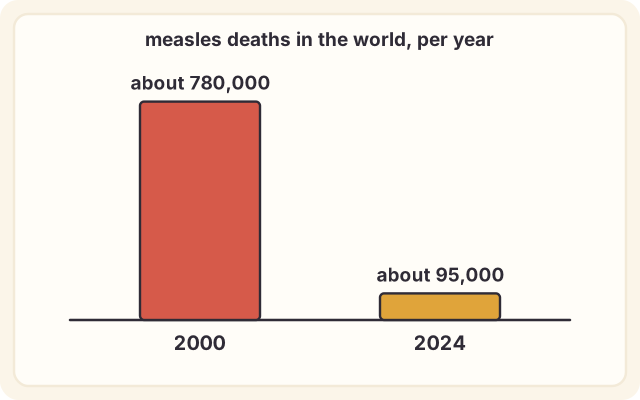
A study for WHO found that vaccines have saved at least 154 million lives in the 50 years since 1974, most of them babies.5 Vaccines for children save over 4 million lives every year.1 Deaths from measles fell from about 780,000 in 2000 to about 95,000 in 2024, mostly thanks to vaccination.2
Side effects
Like any medicine, vaccines can have side effects. Most are mild and short: a sore, red arm for 2 or 3 days, or feeling a bit unwell or slightly feverish for a day or two. A serious allergic reaction is rare, and the person who gives the vaccine is trained to treat one straight away.6
Myth or fact? The MMR vaccine (measles, mumps and rubella) causes autism.
Show the answer
Myth. The idea came from a small paper in 1998, which was found to be dishonest and was withdrawn in 2010. Since then, large studies have looked for a link and found none. One followed over 650,000 children in Denmark and found no higher risk of autism in vaccinated children.7
It is normal to have questions about a vaccine. A doctor, nurse or pharmacist can answer them.
What you can do
- Keep a record of your vaccinations and your children's, and ask a nurse or doctor which ones you may have missed.
- Take questions about a vaccine to a doctor, nurse or pharmacist, or your country's health service.
Words to know
- vaccine - a harmless version of a germ, or a piece of one, that teaches the immune system to recognise it
- community (herd) immunity - when so many people are immune that a germ can't spread, which also protects those who can't be vaccinated
Big idea
A vaccine lets your immune system practise safely, and when enough people are protected, a germ has nowhere to go.
Sources
-
World Health Organization, Vaccines and immunization: What is vaccination? (questions and answers, 2025). ↩ ↩2 ↩3
-
World Health Organization, Measles deaths down 88% since 2000, but cases surge (news release, 2025). ↩
-
World Health Organization, Global immunization efforts have saved at least 154 million lives over the past 50 years (news release, 2024). ↩
-
NHS, Why vaccination is important and the safest way to protect yourself. ↩
-
Anders Hviid and others, Measles, Mumps, Rubella Vaccination and Autism: A Nationwide Cohort Study (Annals of Internal Medicine, 2019). ↩