Food Is Fuel
It is late morning and you skipped breakfast. Your stomach growls, you feel slow and it is hard to think. Then you eat some bread and cheese, and a little later you are ready to go again. What did the food give you?
Energy you can't see
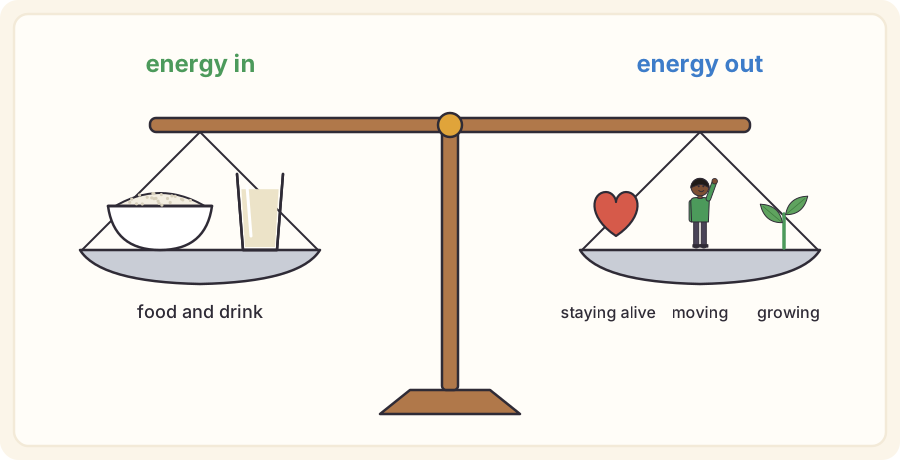
Your body is always busy. Your heart beats, you breathe, your brain thinks, you keep warm, you walk and you grow. All of this needs energy, and that energy comes from what you eat and drink.
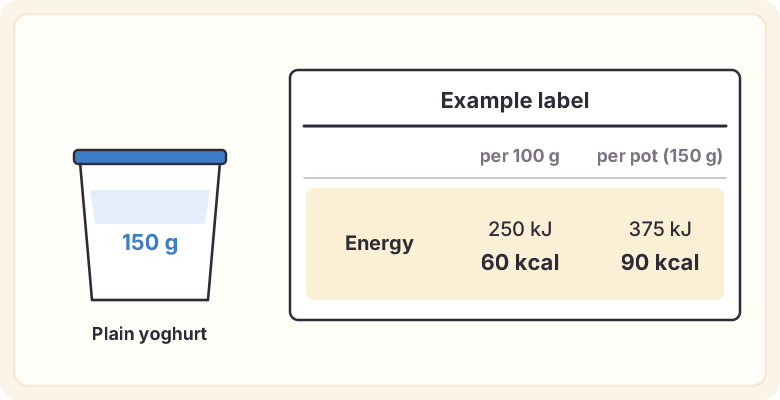
The energy in food is measured in kilocalories (kcal). Most people just say calories. Some labels also give kilojoules (kJ). One kcal is about 4.2 kJ, so the kJ number is always about four times bigger.1
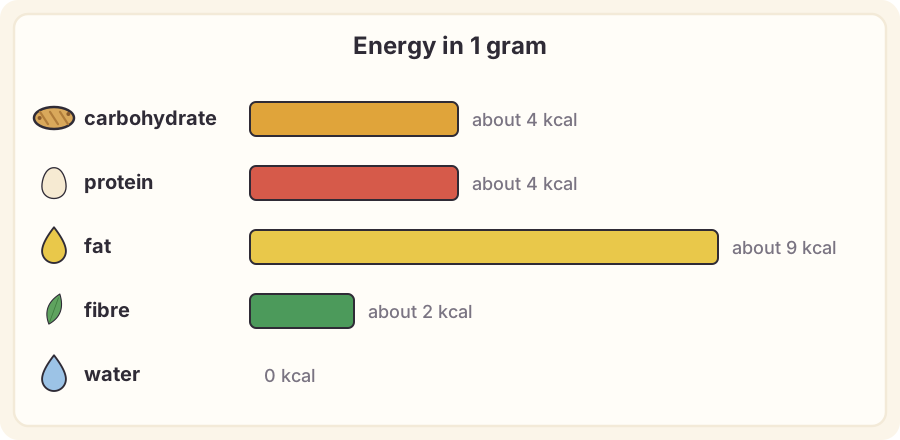
Food is a mix of different parts, and they don't give the same energy. Gram for gram, fat gives more than twice as much as the others:2
- carbohydrate (sugars and starch, as in rice and bread): about 4 kcal per gram
- protein (as in lentils, eggs and meat): about 4 kcal per gram
- fat (as in oil, butter and nuts): about 9 kcal per gram
- fibre (the rough part of plants that the body can't digest): about 2 kcal per gram
Water, a big part of many foods, gives no energy at all.
How much do people need?
The NHS, the UK's health service, says an average woman needs about 2,000 kcal a day and an average man about 2,500.1 These are averages, not targets. Growing teenagers, bigger people and very active people need more. Smaller or less active people need less.
Packaged food usually shows its energy on the label, often both per 100 g and per portion. Per 100 g lets you compare two foods fairly. Per portion tells you what you will really eat, so check how big the portion is.
Energy balance
Energy balance is how the energy you take in compares with the energy your body uses. If the two are about equal, day after day, your weight stays about the same. If you take in more than you use, day after day, the body stores the extra, mostly as fat. If you take in less, it uses up some of its stores.1
This sounds like simple sums, but a body is not a calculator. It changes how hungry you feel, and the kind of food you eat changes how much you end up eating. Body size is also shaped by many things that are not a person's choice (see What Shapes Your Health), so it tells you nothing about how good or hard-working someone is.
What you can do
- On a label, check whether the energy is per 100 g or per portion, and how big a portion is.
- Remember that drinks count too: juice, sweet tea and fizzy drinks carry energy, and sugary ones can add a lot.3
- Think of balance over weeks, not one meal. One big dinner at a wedding doesn't change much.
Words to know
- energy (in food) - what food gives your body to keep it working, moving and growing
- kilocalorie (kcal), calorie - the unit for energy in food; 1 kcal is about 4.2 kilojoules (kJ)
- energy balance - how the energy you take in compares with the energy your body uses
Big idea
Food is the body's fuel. Fat holds the most energy per gram, and over weeks, the balance between energy in and energy out decides what the body stores.
Sources
-
NHS, Understanding calories. ↩ ↩2 ↩3
-
European Union, Regulation (EU) No 1169/2011 on the provision of food information to consumers, Annex XIV (energy conversion factors, 2011). ↩
-
NHS, Water, drinks and hydration. ↩