Sugar and Salt
On a hot afternoon, a cold can of cola feels perfect. At breakfast, bread with salty cheese and a few pickles tastes just right. Sugar and salt make food taste good, and a little of each is fine. But how much is too much, and where do they hide?
Myth or fact? Honey and brown sugar are healthier than white sugar.
Free sugars
Health advice about sugar is not about all sugar. It is about free sugars: sugar added to food or drink by the maker, the cook or you, plus the sugar in honey, syrups and fruit juice. The sugar inside whole fresh fruit and vegetables, and the sugar in milk, are not free sugars.1
Show the answer
Myth. Honey, brown sugar, date syrup and white sugar are all free sugars, and they count the same.1
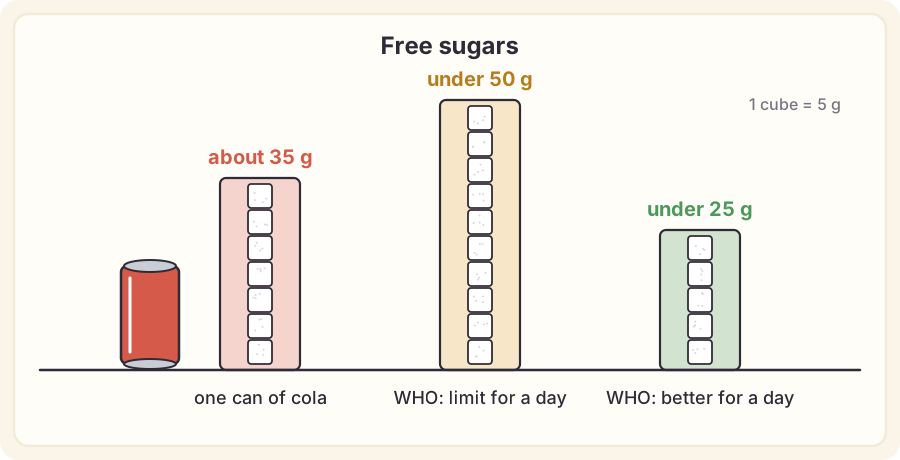
The World Health Organization (WHO) advises keeping free sugars under 10 per cent of the day's energy. For someone eating about 2,000 kcal a day, that is about 50 g, or 12 teaspoons. Under 5 per cent, about 25 g or 6 teaspoons, is even better.1 Too much sugar is linked to weight gain and tooth decay.1
Drinks are where sugar adds up fastest. A 330 ml can of regular cola holds about 35 g of sugar,2 more than the whole 25 g for a day.
Salt and blood pressure
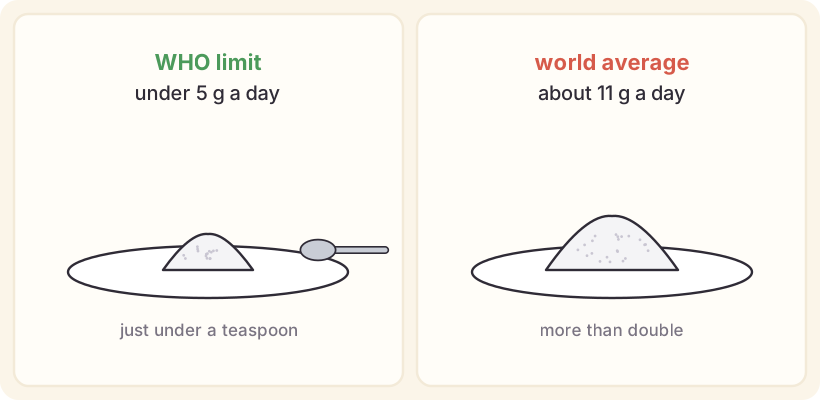
Salt is made of sodium and chloride, and for health it is the sodium that matters. Sodium is a mineral (a substance the body needs in small amounts), but most people eat far more than the body needs. WHO advises adults to eat less than 5 g of salt a day, just under a teaspoon, and children less. In 2021 the world average for adults was about 11 g a day, more than double.3
Too much salt raises blood pressure, the force of the blood pushing on the walls of the blood vessels. Blood pressure that stays high raises the risk of heart attacks, strokes and other diseases of the heart and blood vessels.3
Where does the salt come from?
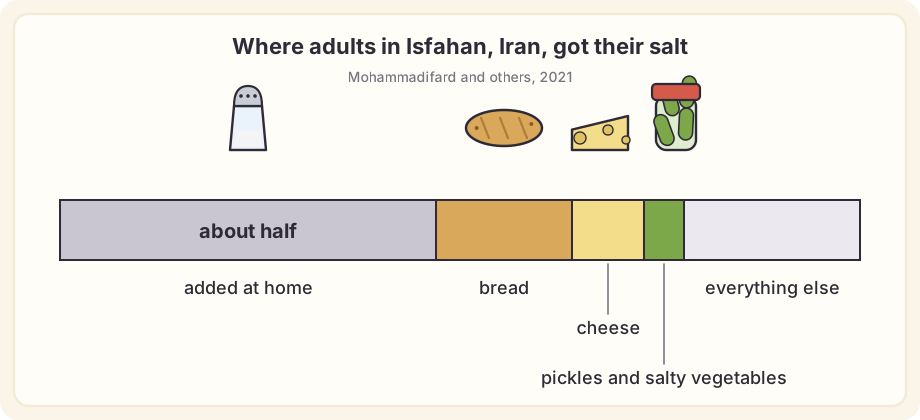
That depends on where you live. In many rich countries, such as those in Europe and North America, much of the salt is already in food people buy: bread, processed meat, snacks and sauces.3 In China and in Iran, much of it is added while cooking or at the table.4
A study in the Iranian city of Isfahan (2014-2015) found that adults ate about 11 g of salt a day. About half was salt added at home. Next came bread, then cheese, then salty vegetables such as pickles.4
What you can do
- Drink water most of the time, and keep sugary drinks and juice small and occasional.
- Cook with less salt, taste before adding more, and keep the salt shaker off the table.3
- Compare labels on bread, cheese and sauces, and choose the less salty ones.
Words to know
- free sugars - sugar added to food and drink, plus the sugar in honey, syrups and fruit juice
- salt, sodium - salt is made of sodium and chloride; sodium is a mineral the body needs only a little of
- blood pressure - the force of the blood pushing on the walls of the blood vessels
Big idea
Keep free sugars low (one can of cola is already a lot) and salt under 5 g a day, and know where your salt comes from: the factory, or your own kitchen.
Sources
-
World Health Organization, WHO calls on countries to reduce sugars intake among adults and children (news release, 2015). ↩ ↩2 ↩3 ↩4
-
World Health Organization, Sodium reduction (fact sheet, 2026). ↩ ↩2 ↩3 ↩4
-
Noushin Mohammadifard and others (2021), Salt intake and its sources in children, adolescents and adults in the Islamic Republic of Iran (Eastern Mediterranean Health Journal). ↩ ↩2