The Placebo Effect
In a test of a new headache pill, some people get the real pill and some get a sugar pill that looks exactly the same. Nobody is told which one they got. Some of the people who took the sugar pill say their headache got better. How can a pill with nothing in it help?
Myth or fact? A sugar pill can cure an illness if you believe in it.
A pill with nothing in it
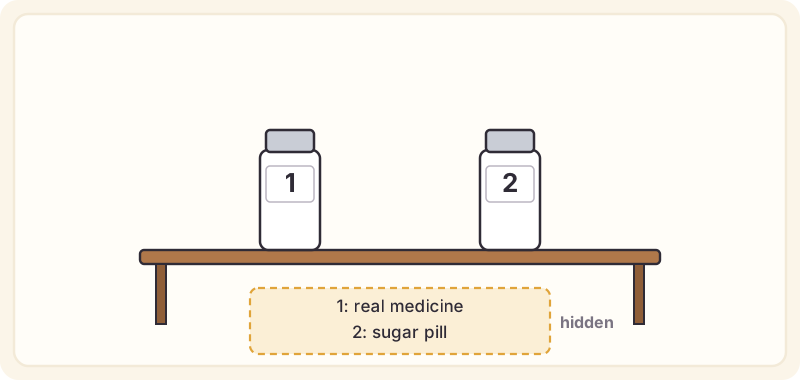
A placebo is a dummy treatment: a sugar pill, or a cream or a drink with nothing in it that should work on the illness. It is made to look, feel and taste like the real treatment. When people feel better after taking a placebo, that is called the placebo effect.
What it can and can't do
A large Cochrane review, which brought together more than 200 trials, compared people given a placebo with people given nothing at all.1 In general it found no important effects. In some trials a placebo made a difference to what people report about themselves, mostly pain and nausea (feeling sick). The review's authors note that even this is hard to separate from people simply reporting what they expect. Things a doctor or a test can measure changed even less.
Show the answer
Myth. A placebo can change how some people feel for a while, mostly pain and nausea. There is no good evidence that it heals an illness or changes what a test can measure.1
A famous mistake
In 1955 an American doctor, Henry Beecher, wrote a well-known paper saying that placebos helped a large share of patients with many different illnesses.2 Later, two researchers read the studies he used again and found a problem.3 Most of the patients he counted as helped by the placebo would have got better anyway: their illnesses were easing by themselves. His studies had no group that got nothing at all, so there was nothing to compare with.
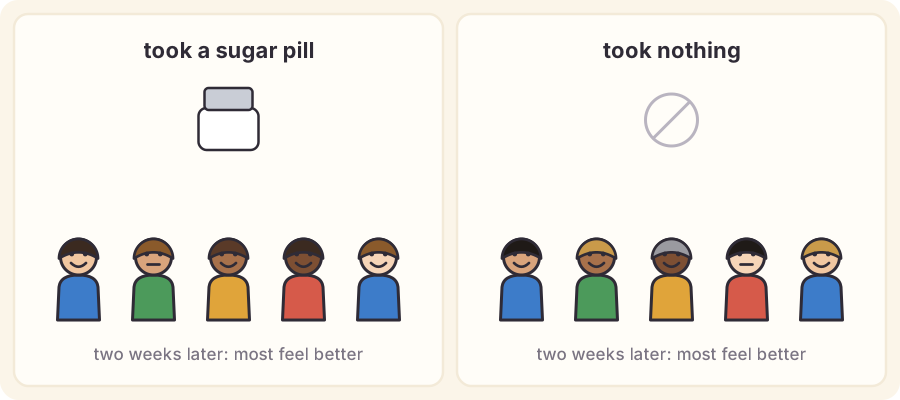
So much of what looks like "getting better on a placebo" is really natural recovery, the body getting better by itself, as in It Worked for Me.
Why trials use a placebo
Knowing what you were given can change how you feel and what you say about it. It can even change what a doctor notices. So many trials give the control group, the group that doesn't get the new treatment, a placebo that looks the same, and they don't tell anyone who got which. Keeping people from knowing this is called blinding. It is the blind test idea used in medicine. Then, if the group on the real treatment does better, the difference can't be explained by hope or expectation, or by natural recovery, because the placebo group had all of those too.
Try it this week
Notice one claim that a treatment "helps many people". Ask: compared with what? Did the people who felt better know what they were taking?
Words to know
- placebo - a dummy treatment, like a sugar pill, made to look like the real one
- placebo effect - feeling better after a placebo, mostly in how you feel rather than in what a test can measure
- blinding - keeping the people in a trial from knowing who got the real treatment and who got the placebo
Big idea
A placebo can change how people feel for a while, but it doesn't heal illness - trials use one, with blinding, so that expectation and natural recovery can't be mistaken for a real effect.
Sources
-
Asbjørn Hróbjartsson and Peter C. Gøtzsche, Placebo interventions for all clinical conditions (Cochrane review). ↩ ↩2
-
Henry K. Beecher, "The powerful placebo", Journal of the American Medical Association (1955). ↩
-
Gunver S. Kienle and Helmut Kiene, The powerful placebo effect: fact or fiction? (Journal of Clinical Epidemiology, 1997). ↩