Protecting Your Hearing
After a loud wedding or a concert, the world sounds muffled, as if your ears were full of cotton. There is a ringing that nobody else can hear. By the next day it has mostly gone. So was it harmless?
Myth or fact? If the ringing goes away, your ears are fine.
How loud is loud?
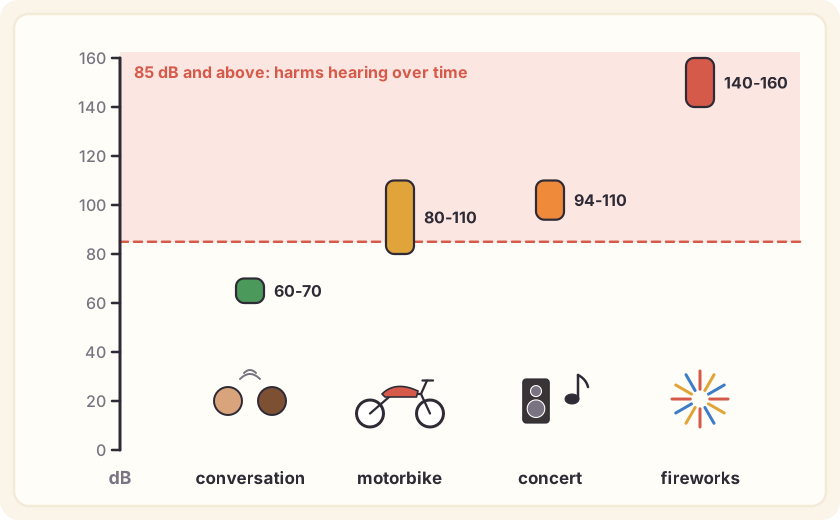
The loudness of a sound is measured in decibels (dB). The US National Institute on Deafness and Other Communication Disorders (NIDCD) gives some examples:1
- a normal conversation: about 60 to 70 dB
- motorbikes: about 80 to 110 dB
- concerts, and music in headphones at full volume: about 94 to 110 dB
- fireworks: about 140 to 160 dB
Sounds of 70 dB or less are unlikely to harm hearing, even after a long time. Long or repeated time with sounds of 85 dB or more can cause hearing loss.1
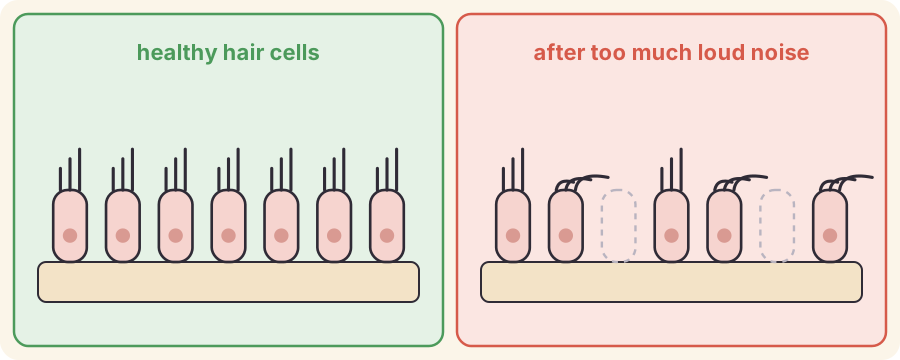
Hair cells don't grow back
Deep inside each ear are rows of tiny hair cells. They turn the shaking of sound into signals the brain can understand. Very loud sound can damage and kill them, and in humans they don't grow back. That is why hearing loss from loud noise, called noise-induced hearing loss, is permanent. It is also the one kind of hearing loss that can be completely prevented.1
Show the answer
Myth. Muffled hearing after a loud evening often gets better within a day or two, because the ear recovers. But some damage may remain,1 and with loud sound again and again, the damage becomes permanent.2 That ringing has a name: tinnitus, a ringing, buzzing or other sound that doesn't come from outside. If it doesn't go away, it can be a sign that hearing has been damaged.2
Loud for how long?
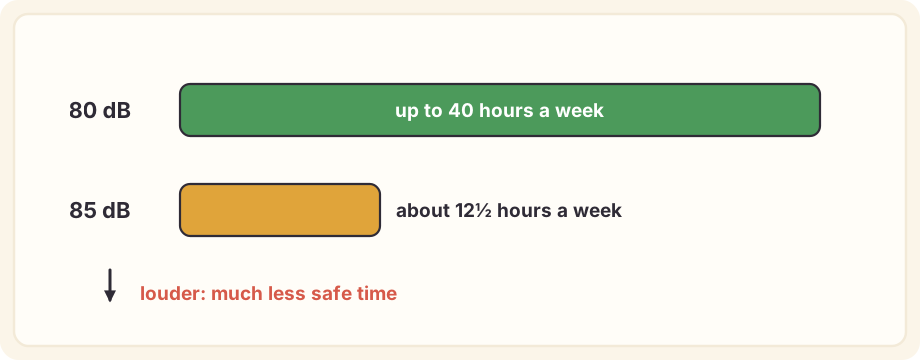
Harm depends on how loud a sound is and how long you hear it. The World Health Organization (WHO) says you can safely listen to 80 dB for up to 40 hours a week. At 85 dB the safe time is only about 12 and a half hours a week, and for louder sounds it is much shorter still.2
This matters for young people most of all. WHO says over 1 billion young adults risk permanent hearing loss because of the way they listen to music and other loud sounds.3
What you can do
- Keep headphones at no more than 60% of the full volume (WHO), and give your ears regular breaks.
- At concerts, weddings, clubs and noisy work, wear earplugs, and stay away from the speakers.
- If ringing doesn't go away, or you find it hard to follow what people say, see a doctor and have your hearing checked.
Words to know
- decibel (dB) - the unit for how loud a sound is
- noise-induced hearing loss - hearing loss caused by loud sound; it is permanent but can be prevented
- tinnitus - a ringing, buzzing or other sound in the ears that doesn't come from outside
Big idea
Loud sound kills hair cells in the ear that never grow back, so keep the volume down, keep loud times short, and protect your ears in noisy places.
Sources
-
National Institute on Deafness and Other Communication Disorders (NIH), Noise-Induced Hearing Loss. ↩ ↩2 ↩3 ↩4
-
World Health Organization, Deafness and hearing loss: Safe listening (questions and answers, 2026). ↩ ↩2 ↩3
-
World Health Organization, Deafness and hearing loss (fact sheet). ↩