Linked Is Not the Same as Caused
A headline on your phone says: "Coffee drinkers live longer." Thousands of people share it. Should you drink more coffee? Before you can answer, you need to know one thing about the study: did the scientists watch people, or did they test something fairly?
Together doesn't prove a cause
Two things happening together doesn't show that one causes the other. It could be chance, or a third thing causing both - the idea of cause or coincidence. In health, this matters every day, because health news is full of links.
Two ways to study health
In an observational study, scientists watch what people do already - what they eat, how much they move, whether they smoke - and see who gets ill over the years. These studies can find links. But people who differ in one habit usually differ in many others too, so a link can come from any of them.
In a randomised trial, chance decides who gets something and who doesn't (random assignment), and then the groups are compared. Because chance made the groups alike, the thing being tested is the only planned difference. So if the groups end up different, that thing is the likely cause.
The pill that went the wrong way
In observational studies, people who ate lots of fruit and vegetables rich in beta-carotene, the orange colour in carrots and mangoes, got lung cancer less often. Perhaps beta-carotene protected them? Scientists in Finland tested it with a randomised trial. For 5 to 8 years, 29,133 men who smoked took beta-carotene pills, or look-alike pills with nothing in them. (Some also took vitamin E, which the same trial tested.)1
The result was a shock. The men taking beta-carotene got about 18% more lung cancer, not less.1
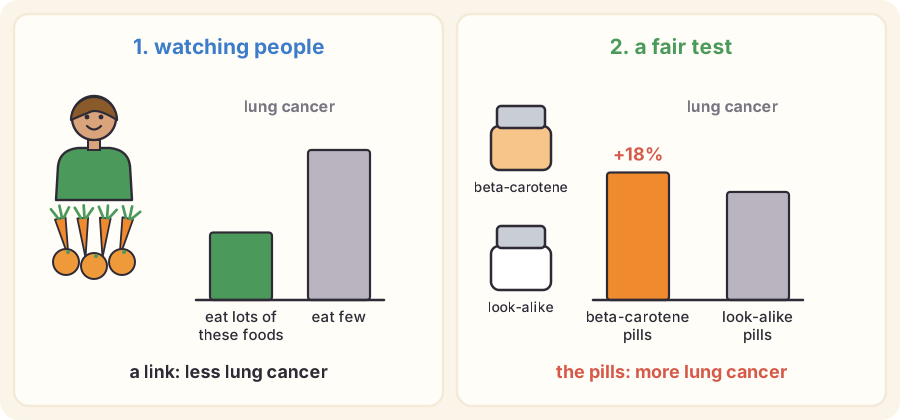
So the link the watchers found didn't come from the beta-carotene itself. Something else explained it: the whole food, or other things about people who eat lots of fruit and vegetables. Only the fair test could show that.
Observational studies are still very useful. They find links worth testing, and some questions can't be tested in a trial at all, because no one may give people something harmful on purpose. But a link on its own is a reason to ask more, not proof.
Reading a health headline
Researchers who teach people to judge health claims list "believing that a link means a cause" as a common trap.2 When you see a headline like the coffee one, ask two questions:
- Did they watch people, or test it fairly?
- What else is different about these people?
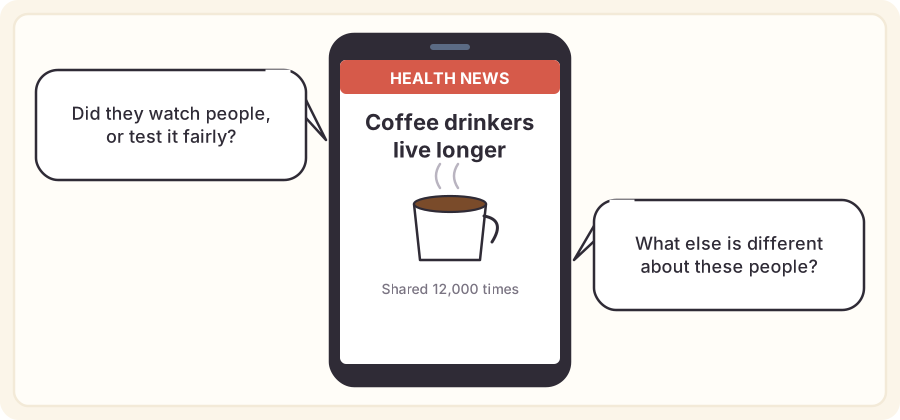
This lesson doesn't say whether coffee is good or bad for you. It shows what a headline like that can and can't tell you on its own.
Try it this week
Find one health headline that says people who do something are healthier. Ask the two questions. Can you think of three other ways those people might be different?
Words to know
- observational study - a study that watches what people already do and looks for links with their health
- randomised trial - a study in which chance decides who gets something and who doesn't, so the groups can be fairly compared
Big idea
Watching people finds links, but only a fair test shows a cause. Beta-carotene looked protective in people who ate it, yet the pills made lung cancer more common.
Sources
-
The Alpha-Tocopherol, Beta Carotene Cancer Prevention Study Group, The effect of vitamin E and beta carotene on the incidence of lung cancer and other cancers in male smokers (New England Journal of Medicine, 1994). ↩ ↩2
-
Informed Health Choices, Key Concepts. ↩