Checking a Health Claim
A video on your phone: a smiling man holds up a bottle. "This secret herbal mix cures diabetes, joint pain and tiredness! Doctors don't want you to know. Thousands say it changed their lives. Order today!" It sounds exciting. What should you make of it?
Warning signs
A health claim is any statement that something is good or bad for your health. Some things should make you slow down. These are warning signs:
- It cures many different illnesses at once.
- It uses words like "miracle", "secret" or "what doctors don't want you to know".
- Its only evidence is personal stories, which can't show a remedy works (see It Worked for Me).
- The person making the claim is selling the product.
- It promises to "detox" or "clean out" your body.
- It mentions no risks at all, as if natural meant safe (see Natural Doesn't Mean Safe).
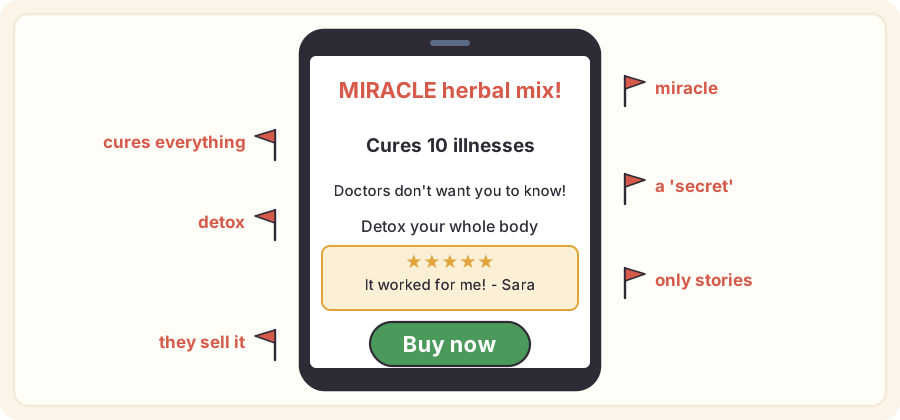
The video in the opening has five of the six.
Questions to ask
Before believing any source, ask who made it, when, and whether reliable, independent sources say the same: checking a source. With a health claim, researchers who teach people to judge claims suggest more questions:1
- Compared with what? Was there a fair comparison with people who didn't get it, as in Lemons at Sea?
- One study or many? A single study can be wrong. Reviews of many studies are stronger.
- Does the person gain from it? Someone selling a product has a reason to praise it.
- Are harms mentioned? Every real treatment can have side effects.
- Is "new" or "everyone uses it" doing the persuading? Neither shows that a treatment works.
Where to look
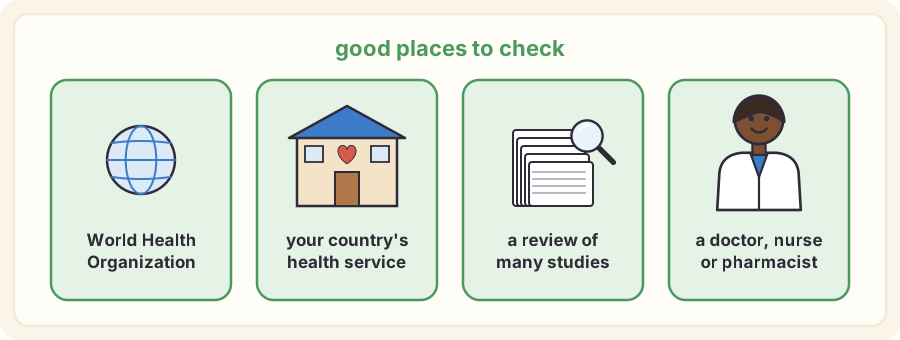
Leave the advert and look somewhere else. Good places are the World Health Organization (WHO), your country's health service, and reviews of many studies, such as those by Cochrane. The best is often a person: a doctor, a nurse or a pharmacist, who can also think about your own health.
These skills can be learned young. In a trial in 120 primary schools in Uganda, children aged 10 to 12 had lessons in judging health claims. Afterwards, 69% of them passed a test of these skills, compared with 27% of children who hadn't had the lessons.2 It was itself a fair test: chance decided which schools got the lessons.
Try it this week
Find one health claim in an advert, a video or a message. Count its warning signs, and ask the five questions. Then look it up in one good source.
The course in one list
- Health is body, mind and life with others going well, not only not being sick (More Than Not Being Sick).
- Get up at the same time every day, and keep caffeine for the morning (Sleeping Better).
- Keep added sugar and salt low (Sugar and Salt).
- Move most days; any amount counts (How Much to Move).
- Wash your hands with soap, and catch coughs in a tissue (How Germs Spread).
- Brush twice a day with fluoride toothpaste (Looking After Your Teeth).
- When stress lasts, move, sleep and talk to someone (When Stress Lasts).
- Keep in touch with the people who matter to you (People Who Keep Us Well).
- And ask "compared with what?" before you believe a health claim.
Words to know
- health claim - a statement that something is good or bad for your health
- warning signs - features of a claim that should make you slow down and check, like "miracle", "cures everything" or a seller praising their own product
Big idea
A strong health claim needs a fair comparison, not a story - watch for the warning signs, ask who gains, and check with a good source.
Sources
-
Informed Health Choices, Key Concepts. ↩
-
Allen Nsangi and others, Effects of the Informed Health Choices primary school intervention on the ability of children in Uganda to assess the reliability of claims about treatment effects (The Lancet, 2017). ↩